The Ghost of the M.V. Sun Sea: A Legal Battle Over Safety and Sovereignty
The arrival of the M.V. Sun Sea on British Columbia’s shores in 2010 remains one of the most significant moments in Canadian immigration history. Sixteen years later, the echoes of that voyage continue to resonate in Canadian courts. At the center of the current debate is Kumar Thuraisinkam, a Toronto-based carpenter whose fight to remain in Canada has reignited a complex conversation about human rights, national security, and the evolving political landscape of Sri Lanka.
A Conflict of Safety vs. Due Process
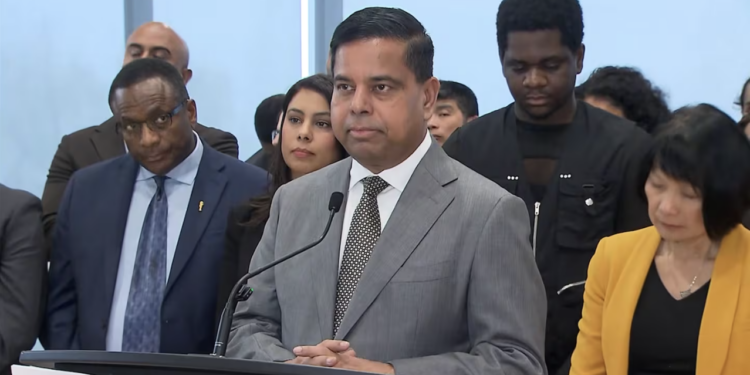
Public Safety Minister Gary Anandasangaree recently addressed the government’s stance on Thuraisinkam’s looming deportation. While acknowledging the historical dangers faced by Tamil migrants, Anandasangaree maintained a disciplined distance from the specific removal proceedings.
“I have, in the past, advocated for those who particularly came on the M.V. Sun Sea… however, I do believe the courts, in Canada, will be the best place to adjudicate this matter,” Anandasangaree stated.
The Minister’s position is a delicate one. Before entering politics, he was a lawyer with the Canadian Tamil Congress, advocating for the 492 people who arrived on the cargo ship fleeing the aftermath of the Sri Lankan Civil War. His current refusal to intervene underscores the government’s reliance on the judicial system to balance individual safety against immigration enforcement.
The Argument for Protection
Thuraisinkam’s lawyer, Kes Posgate, argues that returning to Sri Lanka is essentially a death sentence. The core of their argument rests on:
-
Perceived Affiliation: The risk that the Sri Lankan government will view any passenger of the M.V. Sun Sea as a member of the Liberation Tigers of Tamil Eelam (LTTE), a group listed as a terrorist organization in Canada.
-
Past Precedents of Torture: The case of Sathyapavan “Sathi” Aseervatham, a man involved in organizing the ship who alleged he was tortured upon his return to Sri Lanka in 2013.
-
The Climate of Suspicion: Thuraisinkam maintains he fled years of gunfire and violence, only to be viewed with suspicion by the victorious Sri Lankan army.
Despite these fears, the Canada Border Services Agency (CBSA) has moved forward with removal proceedings, citing a lack of documentation proving a specific, current threat against Thuraisinkam.
The Evolution of the Migrant Experience
The journey of the M.V. Sun Sea was harrowing—a month-long voyage on an old, overcrowded cargo ship with little food and constant fear. For Thuraisinkam, the 16 years following that journey have been a mixture of labor and loss.
| Status | Details |
| Current Profession | Carpenter in Scarborough |
| Family Status | Wife and three children remains in Sri Lanka |
| Legal Hurdle | Refugee claim denied; removal triggered by a more recent impaired driving conviction |
| Personal Toll | Reported struggles with depression and alcohol use due to family separation |
A Changing Sri Lanka?
The Canadian government’s current stance is complicated by claims that the political environment in Sri Lanka has shifted. While the new government asserts that Tamils are being treated with greater equality, advocacy groups remain skeptical. The Canadian Council for Refugees previously noted that while 63% of M.V. Sun Sea claimants were accepted, those left in the “denied” category—like Thuraisinkam—now face a legal system that must decide if the dangers of 2010 are still a reality in 2026.
As the Federal Court prepares to hear Thuraisinkam’s arguments, the case stands as a litmus test for how Canada treats those who arrived in desperation, worked in the shadows for over a decade, and now fear that their past will catch up to them in a country they no longer recognize as home.