AKD Draws the Line: No Sacred Cows in Sri Lanka’s Anti-Corruption Drive
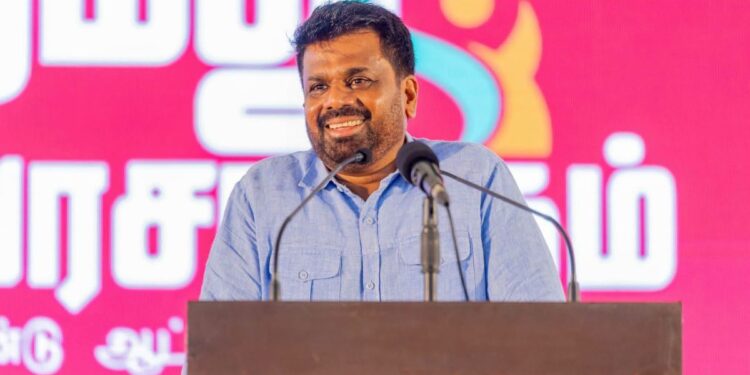
KAHATAGASDIGILIYA, Sri Lanka — President Anura Kumara Dissanayake has delivered an unmistakably combative message to Sri Lanka’s political establishment: power, family connections and political status will no longer be a shield against allegations of corruption.
Addressing a large NPP rally in Kahatagasdigiliya on Sunday (13), Dissanayake made clear that his government intends to push ahead with investigations into the misuse of public funds, regardless of who stands in the dock.
Responding to reported calls from a former minister for limits on arrests, the President rejected the notion outright.
There would be “no limit” to action against those accused of stealing public money, he said, stressing that investigations would proceed through the appropriate institutions and courts.
The message was aimed squarely at a political culture that has long been accused of protecting its own.
No Big Names, No Political Families
Dissanayake was particularly blunt when addressing the question of political influence over corruption investigations.
“Whether he is the big man, the big man’s son or his wife is irrelevant to me,” he said.
That statement goes beyond rhetoric. It represents a direct challenge to one of Sri Lanka’s most persistent political traditions — the idea that powerful families and well-connected politicians operate by a different set of rules from ordinary citizens.
The President said investigative and judicial institutions had been given independence and resources to do their jobs.
But the real test will not be the speeches. It will be whether those institutions can pursue politically connected suspects all the way through investigation, prosecution and judgment without interference.
“Close the Political Doors to Thieves”
Dissanayake also took aim at what he sees as the deeper problem: a political system in which allegations of corruption do not necessarily end a politician’s career.
Sri Lanka, he argued, must create a political culture in which those accused of stealing public property cannot simply return to Parliament, secure another nomination and continue their political careers.
“We need to build a future in which the political doors are closed to those who steal,” he said.
It is a powerful proposition in a country where public anger over corruption and economic mismanagement helped fuel the political upheaval of recent years.
But it also places a heavy burden on the NPP itself. If the government is serious about changing political culture, its standards must apply consistently — to allies as well as opponents, and to the powerful as well as the politically expendable.
A Direct Shot at the Old Guard
The President did not stop there.
Referring to the SLPP rally in Anuradhapura on Saturday, Dissanayake described those defending people accused of corruption as a “small tribal group.”
He then delivered one of his sharpest political blows:
“The dream of a son becoming President simply because his father is President is now over.”
The remark was an unmistakable attack on dynastic politics and the concentration of political power within a handful of families.
For decades, Sri Lankan politics has been dominated by powerful political names and family networks. Dissanayake is now attempting to turn the rejection of that model into a defining feature of the NPP’s political identity.
Whether voters ultimately accept that argument will depend on whether the government can demonstrate that it is building institutions rather than simply replacing one political establishment with another.
The Money Trail
The President also claimed that the government had uncovered more than US$1 billion, approximately Rs. 300 billion, allegedly siphoned out of the country.
That is an extraordinary figure.
Dissanayake said the government was targeting illegal financial operators involved in moving money overseas through illicit channels.
If substantiated through investigations and court proceedings, such revelations could expose the scale of the financial networks that have operated beyond effective public scrutiny.
But again, the government must now provide results. Claims of billions being moved out of the country will demand evidence, prosecutions, asset recovery and convictions where wrongdoing is established.
Sri Lankans have heard many promises of accountability before. What they want now is not another political spectacle, but consequences.
The War on the Underworld
Dissanayake also highlighted the government’s campaign against drugs and organised crime, saying more than 70 suspects had been arrested overseas and brought back to Sri Lanka.
He described the operation as the country’s largest campaign against the drug trade and underworld.
The claim, if sustained by continued enforcement action and successful prosecutions, could mark a significant escalation in the state’s battle against organised criminal networks.
For a government seeking to establish its credentials as a force for law and order, the coming months will be critical.
From Anti-Corruption to Development
The President’s speech was not confined to crime and corruption.
He pointed to more than Rs. 97 billion worth of two major development projects — the Kabithigollewa Water Supply Project, valued at over Rs. 50 billion, and the Lower Malwathu Oya Reservoir Project, valued at more than Rs. 47 billion.
These projects are particularly significant for rural communities where water security and agriculture are directly tied to livelihoods.
The NPP’s political challenge is therefore becoming increasingly clear: it must convince voters that its campaign against corruption is not an end in itself, but part of a larger economic transformation.
Human-Elephant Conflict: A Test of Government Capacity
Dissanayake also addressed one of rural Sri Lanka’s most persistent problems — the human-elephant conflict.
He announced plans to recruit more than 3,000 wildlife assistants, while examinations have been completed to recruit more than 5,000 wildlife officers. A further 5,000 Civil Security Department personnel are to be attached to the Department of Wildlife Conservation.
The numbers are substantial.
But manpower alone will not solve a crisis involving habitat loss, agricultural expansion, weak land-use planning and inadequate wildlife management. The government will ultimately be judged by whether farmers are safer and whether Sri Lanka’s elephant population can be protected.
A New Education System
Looking beyond immediate political battles, Dissanayake promised the introduction of a new education system from January, designed to connect Sri Lankan children with leading international education systems.
He also promised improvements to healthcare and public transport.
These are ambitious commitments, and potentially transformative ones. Yet they are precisely the areas in which governments are often judged most harshly: not by policy documents or speeches, but by what parents, students, patients and commuters experience every day.
The NPP’s Moment of Truth
Dissanayake insists that his government faces “no threat whatsoever.” His confidence is unmistakable.
But political power is never permanent.
The NPP came to power promising to break with the political practices that had dominated Sri Lanka for generations. That promise is now being tested.
The President has drawn a line between his government and the old political culture — between accountability and impunity, institutions and political interference, public property and private enrichment.
The rhetoric is powerful.
The stakes are even higher.
If corruption investigations produce credible prosecutions, stolen assets are recovered, organised crime is dismantled, development projects are delivered and public services genuinely improve, Dissanayake may succeed in turning the NPP’s promise of political transformation into a lasting reality.
If not, the accusation will be inevitable: that the old political culture did not disappear, it merely changed its colours.
Sri Lanka’s voters have heard enough promises.
Now they will be watching the results.