Putin Orders ‘Protection’ of Russia’s Youth Camps Amid EU Sanctions Over Ukrainian Children
In May, the EU sanctioned Russian officials and entities, targeting those responsible for the unlawful systematic deportation, including indoctrination, militarised “re-education,” and adoption of Ukrainian children. The Kremlin leader Vladimir Putin ordered security services to protect children’s camps on Wednesday, condemning European sanctions against youth organizations.
Kremlin leader Vladimir Putin has ordered security services to tighten protection of children’s camps across the country just weeks after the European Union imposed sanctions on Russian officials and youth centers, targeting those responsible for the systematic unlawful deportation and indoctrination of displaced Ukrainian children.
According to a Russian media outlet Kommersant, Putin ordered the country’s special services and law enforcement agencies to protect children’s centers, camps and health resorts, as more than 5.75 million children in Russia are expected to spend their vacations in such facilities.
“During the summer holidays, children’s centers, camps, and health resorts must be reliably protected,” Putin said, explaining that once again he “draws the attention of the heads of special services and all law enforcement agencies to the need to strengthen anti-terrorist security,” with a special focus on general security in the educational system.
He added that if European countries “are concerned with gender issues and the protection of various sexual minorities, if they are irritated by the sight of happy children who love Russia, then it means we are doing everything right.”
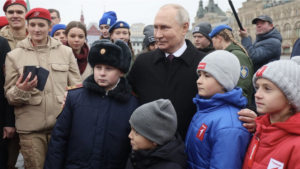
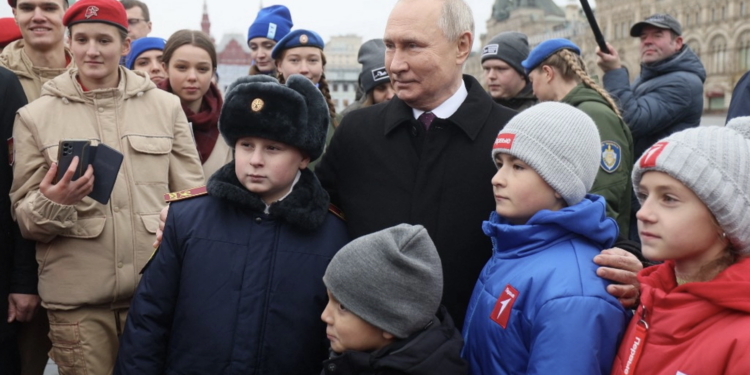
This pool photograph distributed by Russian state owned agency Sputnik shows Russia’s President Vladimir Putin (C) posing for pictures with volunteers and children of late Russian servicemen during a wreath-laying ceremony at the Monument to Minin and Pozharsky on Red Square on the National Unity Day in Moscow on Nov. 4, 2023. (Photo by Gavriil GRIGOROV / POOL / AFP)
EU imposes sanctions on Russian officials and youth camps
In May, the EU adopted new restrictive measures against 16 individuals and 7 entities linked to Russia’s war in Ukraine, targeting those accused of unlawful deportations and forced transfers, as well as forced assimilation and indoctrination of Ukrainian minors.
According to the European Council, Russia is estimated to have deported or forcibly transferred nearly 20,500 Ukrainian children since the beginning of Russia’s full-scale invasion of Ukraine. The EU Council described those actions as grave breaches of international law and violations of children’s fundamental rights.
Among those listed are federal state institutions tied to the Russian Ministry of Education, including the All-Russian Children’s Centres Orlyonok, Scarlet Sails, and Smena.
Reportedly, these centres run programs in coordination with occupation authorities, subjecting Ukrainian children to pro-Russian ideologies.
Other sanctioned entities include the DOSAAF Centre in Sevastopol, the Nakhimov Naval School and the Military-Patriotic Club “Patriot” in Crimea.
The list also includes other officials and politicians from Russian-occupied regions and heads of youth camps and military organisations, who are accused of indoctrinating Ukrainian children through exposure to Russian military culture and paramilitary training.
“Those listed are subject to an asset freeze, and EU citizens and companies are forbidden from making funds, financial assets or economic resources available to them,” the Council said, adding that all “natural persons are additionally subject to travel ban that prohibits them from entering or transiting through EU territories.”
Queer rights in Russia
Currently, Russia recognizes LGBTQ+ movements as extremist, banning them completely, as they reportedly pose a threat to the country’s demographic growth and economic development.
According to Putin, these kinds of movements and queer rights are evidence of moral decay in Western countries, and anyone portraying “LGBT propaganda” can be subjected to fines and even jailed.
The exact amount of the fines remains unknown, but under Russian law, individuals can be fined up to 200,000 rubles (about €2,200) for disseminating materials online that the authorities deem to promote non-traditional sexual relations.
Despite having one of the highest divorce rates in the world, as well as high levels of alcoholism and domestic violence, Russian leadership has long attempted to portray the Russian Federation as a bastion of traditional family values.