South Korea Expresses Regret Over U.S. Worker Arrests Amid Rising Tensions and Billions in Investment
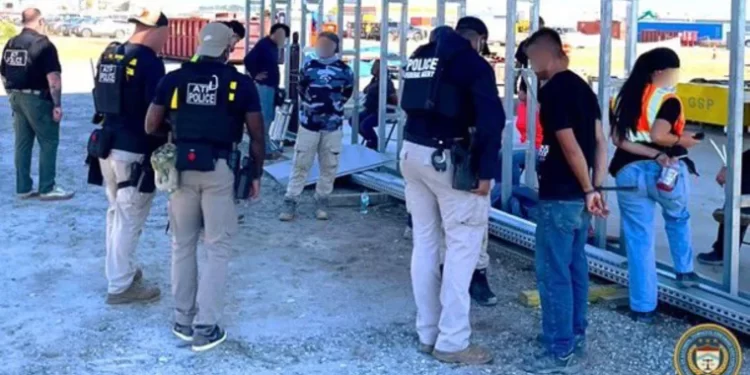
South Korea’s government expressed deep regret following the arrest and public detainment of Korean workers at a major U.S. construction site, calling the footage released by American immigration authorities “concerning” and urging swift diplomatic engagement to prevent further escalation.
The arrests took place during a large-scale operation by the U.S. Department of Homeland Security (DHS), which involved armored vehicles and heavily armed personnel. Video footage showed dozens of workers being detained in shackles, many of them employed at a $4.3 billion electric vehicle (EV) battery plant in Georgia, a flagship project jointly undertaken by Hyundai Motor Company and LG Energy Solution. The facility is considered one of the largest economic development projects in Georgia’s history.
DHS officials confirmed that the operation was carried out under a judicial search warrant as part of an investigation into alleged unlawful employment practices. A customs official noted that many of those arrested lacked proper authorization to work in the United States, having either crossed the border illegally or overstayed their visas.
In a rare public statement, South Korea’s presidential chief of staff Kang Hoon-sik said on Sunday that Seoul was seeking to “improve the visa system” for Korean workers traveling to the U.S. and pledged to work closely with Washington to ensure that “a similar incident does not occur in the future.”
“We deeply regret both the arrests and the manner in which they were publicized. These images not only humiliate the individuals involved but also threaten to undermine mutual trust at a critical moment in our bilateral relationship,” Kang said.
Economic Ties at Stake
The diplomatic strain comes at a sensitive time, as both countries work to finalize the details of a major bilateral trade deal announced in July. The agreement includes a $350 billion fund aimed at facilitating South Korean corporate investment in the U.S. economy. Hyundai, one of South Korea’s flagship conglomerates, recently pledged to increase its U.S. investments to $26 billion, including the construction of a robotics facility.
The workers detained in the Georgia raid were reportedly involved in that very expansion, employed at the joint Hyundai-LG battery plant intended to supply parts for next-generation electric vehicles. In response to the arrests, LG Energy Solution has suspended all non-essential staff business trips to the United States and is recalling Korean employees currently stationed there.
Political Reverberations
While DHS has maintained that the operation was standard enforcement of U.S. immigration law, critics in both countries warn that the fallout could have far-reaching consequences. Seoul officials have privately voiced frustration that their citizens, many of whom were part of strategic industrial deployments, were treated with excessive force.
Diplomatic observers note that the incident comes just weeks ahead of a possible visit to South Korea by former U.S. President Donald Trump, who may attend the Asia-Pacific Economic Cooperation (APEC) summit in October. Trump’s potential visit, his first since leaving office, could further politicize the immigration and trade debate, especially if he uses the event to criticize the Biden administration’s handling of foreign labor and international investment.
A Test for Alliance Management
Despite close military and strategic ties, the U.S.-South Korea alliance has faced new challenges in the post-pandemic era, particularly around trade, supply chains, and labor mobility. South Korea is a major contributor to U.S. industrial policy goals, especially in the clean energy and semiconductor sectors. The EV battery facility under construction is a cornerstone of that collaboration.
Yet, the arrest of Korean nationals, in such a high-profile and public fashion, risks chilling enthusiasm at a moment when both countries are trying to reinforce economic integration.
“This incident is more than an immigration issue, it’s a test of how the U.S. and South Korea manage their increasingly intertwined economic destinies,” said a senior official at the Korean Ministry of Trade, speaking on condition of anonymity. “The optics matter.”
As the two governments work behind the scenes to contain the fallout, attention now turns to what concrete steps will be taken to ensure the rights and mobility of foreign workers, and whether this incident will become a stumbling block or a catalyst for reform in the U S – Korea labor relations