When Faith Is Used as a Shield, Questioning Is Not the Sin
When monks speak publicly, enter politics, conduct business, accumulate wealth, or live in ways openly contrary to the Vinaya, they have already stepped into the public square. Critiquing such conduct does not undermine Buddhism; it protects it from being hollowed out by those who use it as cover.
An open letter written in the shadow of Cardinal Malcolm Ranjith’s latest sermon
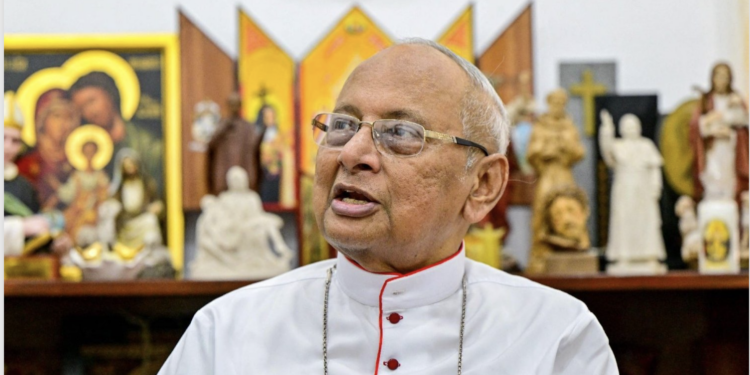
On February 4 in Colombo, at a service marking Sri Lanka’s Independence Day, Cardinal Malcolm Ranjith issued a warning. He accused several ministers in the present government of insulting Buddhist monks and other members of the clergy, arguing that such disrespect would lead the nation toward destruction rather than prosperity. Sri Lanka’s culture, he reminded the congregation, is deeply rooted in Buddhism, introduced by Arahath Mahinda, and undermining religious leadership, he said, would only deepen the country’s economic and moral crisis.
It was a familiar message: reverence for clergy as a prerequisite for national survival, criticism framed as sabotage, and religious authority cast simultaneously as guardian and victim of national decline.
Yet this warning arrives at a strange moment. The most intense conflict involving Cardinal Ranjith today is not with politicians, but with his own faithful.
Before we are warned that questioning religious leaders leads to destruction, we must ask a more fundamental question: when did exposing wrongdoing become an attack on religion?
Across Sri Lanka, there are monks who speak of restraint while living without it; who preach renunciation while running businesses; who wear the yellow robe while quietly maintaining families, fathering children, cultivating wealth, political access, and personal power. Some reinvent themselves as public personalities, complete with dreadlocks and entourages. Others hide behind temple walls, relying on reverence and fear to enforce silence.
Why is critique forbidden?
It is not critics who damage Buddhism. It is hypocrisy protected by the robe. A religion founded on discipline, detachment, and moral clarity is not weakened by scrutiny; it is weakened when those who violate its principles are shielded from accountability in the name of “respect.”
Accountability is not an insult. Silence is not reverence.
And robes of any color are not immunity.
An Open Letter to His Eminence, Cardinal Malcolm Ranjith
Your Eminence,
I write not as an enemy of the Church, but as someone born into it, raised by it, and still unwilling to abandon it despite everything.
You have warned the nation that questioning religious leaders leads to destruction, economic collapse, moral decay, and social ruin. You argue that clergy must be protected from criticism so they may guide society toward stability.
Yet, at the same time, you have identified through your own actions what appears to be the greatest crisis facing the Catholic Church today:
Girls. At the altar. Holding candles.
In October, you decreed that female altar servers would no longer be permitted in the Archdiocese of Colombo. Canon law allows their service. Rome clarified this in 1994. Pope Francis amended the law again in 2021, explicitly including women as acolytes. Yet Colombo chose another path.
Your explanation was simple: girls at the altar discourage priestly vocations.
This is a remarkable theological discovery. For decades, Catholics believed vocations were nurtured by faith, integrity, example, and trust. We now learn they are undone by a teenage girl carrying a missal.
As someone raised in a devout Catholic family, I find this explanation oddly comforting because it distracts attention from far more uncomfortable questions.
I was twelve years old when I watched a poor woman offer ten rupees to a parish priest. He blessed her, thanked her, and handed the money to an aide with instructions to bring him a pack of cigarettes. That moment taught me about power, entitlement, and example. Was that good for vocations?
I remember a woman whose husband worked abroad slipping into Kochchikade church on a scooter, disguised in a sarong, shirt, and full-face helmet to conceal her identity while meeting a priest in the night. She was noticed by neighbours, arrested by police, and publicly humiliated. The church itself went untouched. The priest remains in service. The incident faded quietly, as so many others do.
I remember a parish priest from Pallansena church who secretly maintained a family, complete with a child. This was widely known. There was no public accountability, only a quiet resignation. That person is now serving in a Christian church as a priest. The dust was swept beneath a very holy carpet. You knew. The faithful knew. We were told nothing.
Silence followed. Always silent.
Now you warn that questioning religious leaders leads to national ruin. But, Your Eminence, the destruction did not begin with questions. It began with answers never given.
Sri Lanka’s economy is indeed in crisis. Trust in institutions is shattered. Young people are leaving churches, temples, and mosques alike. But if this collapse of faith is blamed on altar girls rather than on the absence of accountability, then the Church is not facing a vocations crisis.
It is facing a reality crisis.
You rightly object when monks are insulted. No faith deserves mockery. But respect cannot be demanded while scrutiny is forbidden. Free speech cannot be sacred only when it praises and sinful when it questions.
The irony is almost liturgical.
The altar is not losing boys because girls are present.
The Church is losing people because truth is absent.
And no ban, no warning of destruction, and no appeal to fear will restore faith until honesty returns to the center of worship.
With respect, from someone who still believes the Church can be better than this.