Sri Lanka Unveils Ambitious Trade and Governance Agenda at World Economic Forum 2025
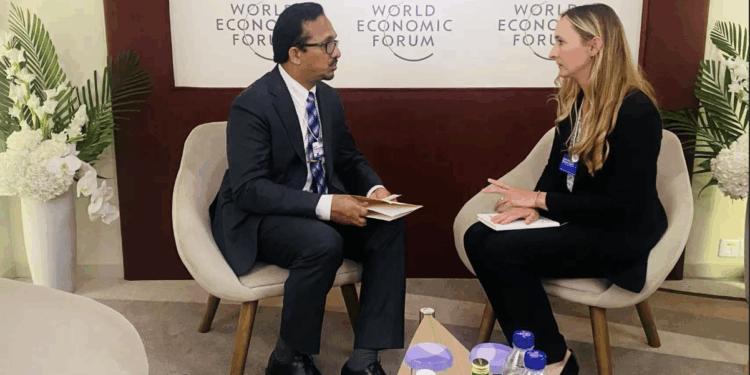
Davos, Switzerland – July 1, 2025. At this year’s World Economic Forum (WEF), Sri Lanka made a compelling case for its emergence as a responsible and strategically positioned global trade partner. Led by Minister of Industry and Entrepreneurship Development Sunil Handunnetti, the Sri Lankan delegation outlined a robust trade and governance strategy designed to reposition the nation within a rapidly evolving global economy.
In a pivotal bilateral meeting with Kimberly Botwright, WEF’s Head of Sustainable Trade, Minister Handunnetti presented Sri Lanka’s five-pronged approach to redefining its international trade posture.
1. Strategic Positioning in the Indian Ocean
Reaffirming its commitment to transparent, rules-based trade, Sri Lanka highlighted its geographical advantage at the crossroads of major global shipping routes. As the current Chair of the Indian Ocean Rim Association (IORA), the country is seeking to leverage its location as a key logistics and trade hub, particularly amid rising concerns over global economic fragmentation.
2. Trade Realignment Toward Asia and Africa
With global trade dynamics shifting, Sri Lanka is recalibrating its economic ties by strengthening partnerships across Asia and Africa. The minister referenced ongoing trade negotiations with China and Singapore, and a proposed pact with Indonesia, as examples of this new orientation. In tandem, the country aims to enhance the value of its major exports, such as apparel and tea, by integrating environmental, social, and governance (ESG) principles and fostering innovation.
3. Championing Responsible Trade
Sri Lanka emphasized its adherence to international labor and environmental standards, aiming to remain compliant with regulations from major markets like the U.S. and EU. The country proposed green economy collaborations focused on sustainable ocean industries and renewable energy, reinforcing its image as a responsible and forward-thinking trading partner.
4. Addressing Structural Trade Barriers
During discussions, Minister Handunnetti called on the WEF to support Sri Lanka’s request for the reinstatement of key U.S. trade benefits under programs like the Generalized System of Preferences (GSP+). He also raised concerns over non-tariff barriers, particularly those affecting palm oil trade with Indonesia. Furthermore, Sri Lanka sought technical assistance to enhance digital infrastructure and make e-commerce more accessible for small and medium-sized enterprises (SMEs).
5. Institutional Reforms and Global Alignment
To build a more resilient and future-ready trade environment, Sri Lanka announced plans to align its trade policies with global frameworks such as the Comprehensive and Progressive Agreement for Trans-Pacific Partnership (CPTPP) and the Regional Comprehensive Economic Partnership (RCEP). The country invited the WEF to help facilitate investment dialogues and offer institutional support to build local capacity.
A Call for Strategic Partnership
In a forward-looking proposal, Sri Lanka recommended the formation of a joint WEF-Sri Lanka Task Force to operationalize the presented initiatives, with structured quarterly reviews to monitor progress.
“Sri Lanka does not merely seek economic relief, but relevance in a fragmented global trading system,” Minister Handunnetti asserted. Describing the nation as a “bridge between emerging and developed economies,” he called for renewed global partnerships that prioritize sustainability, inclusivity, and innovation.
As the world economy continues to undergo seismic shifts, Sri Lanka’s proactive stance at WEF 2025 signals its determination to not only weather uncertainty but to shape the future of equitable global trade.