Spain’s Masterpiece: The Night They Silenced Messi and Conquered the World Again
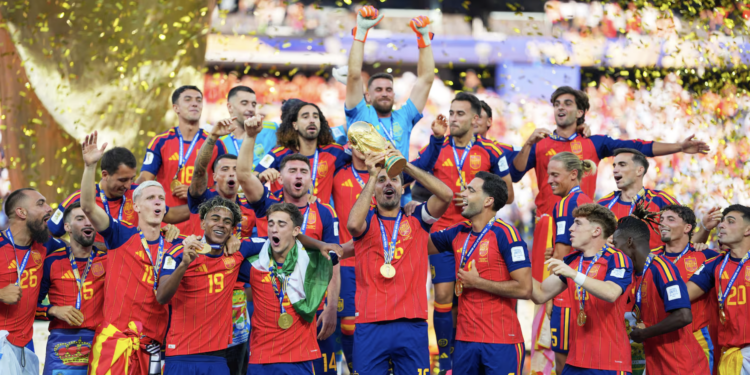
There are World Cup winners. Then there are teams that leave a lasting imprint on football history. Spain did both. On a night filled with emotion, drama, and expectation, the world’s most complete team produced one final masterpiece, defeating Argentina 1-0 after extra time to reclaim the FIFA World Cup. As red shirts erupted in celebration, Lionel Messi, the game’s greatest icon, walked away with tears in his eyes, his quest to defend Argentina’s crown ending against a side that simply refused to crack.
It wasn’t just a victory, It was a football lesson.
For years, the modern game has celebrated breathtaking attacks, relentless pressing, and moments of individual brilliance. Spain arrived at this World Cup with a different philosophy. They didn’t overwhelm opponents with chaos. They suffocated them with control.
Every pass had purpose.
Every movement had meaning.
Every defender knew exactly where to be.
By the time the final arrived, opponents weren’t simply trying to beat Spain, they were trying to survive them.
The defining moment came in the 106th minute.
Argentina, already reduced to ten men after Enzo Fernández’s dismissal late in regulation, failed to clear a dangerous ball inside the penalty area. Ferran Torres, introduced from the bench, reacted in an instant. One touch. One left-footed strike. One unforgettable finish beneath the crossbar.
The goal was not spectacular because of its technique alone.
It was spectacular because it crowned an entire tournament’s worth of excellence.
Torres may have scored the winner, but Spain’s real hero was its identity.
Throughout the tournament, Luis de la Fuente’s side built victory on something increasingly rare in modern football—patience. They monopolized possession, denied opponents rhythm, and defended with remarkable discipline. The numbers tell the story better than any headline ever could: just one goal conceded in eight matches, the fewest ever by a World Cup-winning team.
Champions are often remembered for breathtaking attacks.
This Spain team will be remembered because nobody could score against them.
De la Fuente deserves enormous praise.
At 65, he became the oldest coach to guide a nation to World Cup glory, but more importantly, he built a team that believed completely in one another. There were stars, certainly, but no passengers. Every player embraced the system, sacrificed for the badge, and trusted the process.
That unity transformed Spain from contenders into champions.
It also extended an astonishing unbeaten run to 38 matches, the longest ever by a European men’s national team. Records like that are never accidental.
They are earned.
The final also carried enormous emotional weight because it may well have been Lionel Messi’s farewell on football’s biggest stage.
Few players have ever shouldered expectations like Messi. Fewer still have fulfilled them so completely. His World Cup triumph in 2022, two Copa América titles, countless individual awards, and nearly two decades of brilliance ensured his place among football’s immortals long before this final.
But football has always possessed a beautiful cruelty.
Sometimes legends do everything right.
Sometimes they simply run into a better team.
Sunday belonged to Spain.
Perhaps the most remarkable aspect of this triumph is what it represents beyond a single tournament. By adding the men’s World Cup to the women’s title won in 2023, Spain became the first nation ever to hold both crowns simultaneously—a reflection of a football culture producing excellence at every level.
This wasn’t built overnight.
It was built through coaching, development, tactical identity, and unwavering belief.
The 2026 World Cup itself was unlike anything football had ever seen. Expanded to 48 nations and staged across the United States, Canada, and Mexico, it delivered record crowds, hundreds of goals, and a spectacle that stretched far beyond the pitch. Global music icons, Hollywood stars, and football legends gathered to witness history.
And history delivered.
Yet when the lights dimmed and the celebrations began, all the entertainment faded into the background. What remained was the image of Spain lifting the most coveted trophy in sport.
No shortcuts.
No miracles.
Just football played almost to perfection.
The brief post-match scuffles could not overshadow the respect shown moments later when Spain’s players formed an honor guard for Argentina as the defeated champions collected their runners-up medals. It was a fitting gesture between two footballing giants who had given everything.
In the end, Spain achieved something far greater than lifting another trophy.
They reminded the football world that greatness isn’t measured only by superstar names or spectacular moments. It is measured by consistency, discipline, teamwork, and the courage to stay true to an identity even under the greatest pressure.
Messi’s legacy remains untouchable.
Argentina’s era will still be remembered with admiration.
But this final belonged to Spain.
Not because they had the biggest star.
Because they were the better team.
And sometimes, that is football’s greatest story of all.
If you want an even more authentic magazine feel, I can also write it in the style of FourFourTwo, World Soccer, or ESPN FC, with punchier openings, more vivid match imagery, and magazine-style subheadings.