Rebuilding or Reproducing the System? Evaluating the NPP’s Progressive Promise
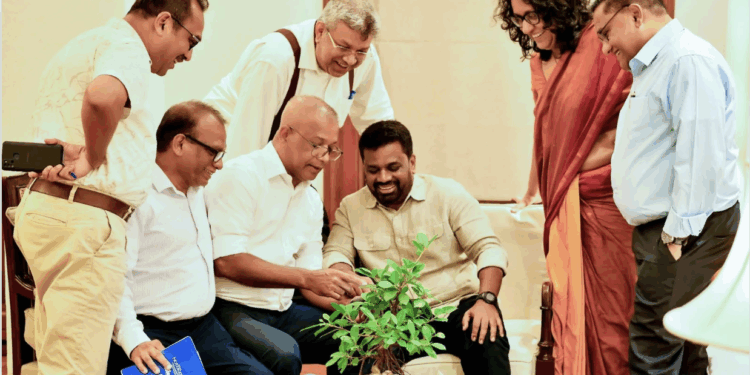
The National People’s Power (NPP) achieved a historic two-thirds parliamentary majority in the November 2024 elections, Sri Lanka’s largest single-party mandate since 1977. Led by the Janatha Vimukthi Peramuna (JVP), the NPP is not simply a political party but a broad alliance of political organisations, trade unions, women’s groups, and civil society actors. Despite attempts to portray it as “radical” or overtly Marxist, the NPP is better understood as a progressive social coalition shaped by the long arc of Sri Lanka’s economic and political crises.
This article evaluates the NPP’s first year in power. It contextualises the coalition’s emergence, examines its tactical and strategic orientation within representative politics, and considers what this means for strengthening democratic social movements. The analysis is an explicitly political reading of the NPP “from below and to the left”: that is, centred on the struggles of marginalised groups and committed to extending democracy into social, cultural, and economic life.
Aragalaya’s Afterlives and the Rise of a New Hegemonic Bloc
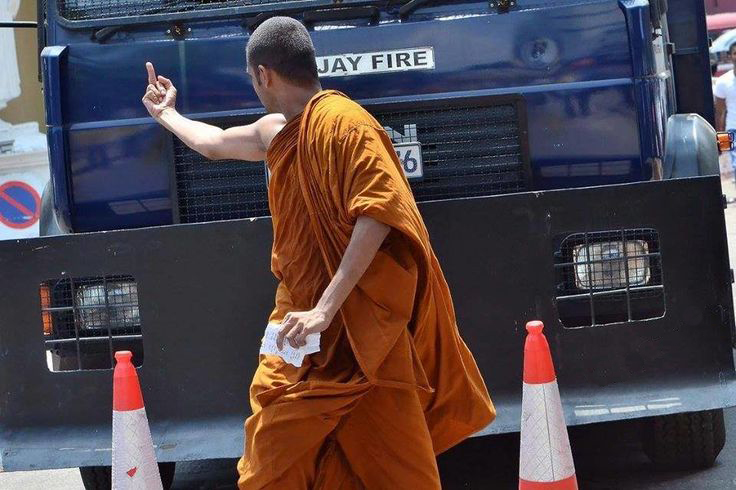
The NPP’s ascent from a marginal “third force” to the party of government was shaped by the 2022 Aragalaya uprising, which ruptured the political alliances that had sustained the Rajapaksa regime. The Aragalaya brought together activists, trade unions, professionals, social movements, and disenfranchised citizens producing a rare moment of political convergence “from below and to the left”.
With the Rajapaksa hegemonic bloc weakened, the NPP constructed a new coalition drawing from many of the same constituencies: business interests, trade unions, religious institutions, the military, media actors, and civil society groups. This new bloc is unified not around a transformative left project, but around an anti-corruption agenda backed by a discourse of efficient economic governance and an inclusive Sinhala-Buddhist cultural imaginary under a militarised state.
Predictably, powerful actors invested in the old order have launched misinformation and disinformation campaigns to delegitimize the NPP as inexperienced or incompetent. Editorials such as The Morning’s “Inexperience is Costly” linked to media magnate and opposition politician Dilith Jayaweera exemplify this ongoing ideological struggle. These narratives are part of an entrenched class war from above, mobilised to undermine the NPP’s credibility.
Political Economy: The Deep Structure of Sri Lanka’s Crisis
Sri Lanka’s political economy since 1977 has been shaped by neoliberal liberalisation, deregulation, and the rollback of the welfare state. Party politics became inseparable from patronage, family dynasties, and a rentier elite profiting from asset ownership rather than productive labour. A national-popular project grounded in Sinhala-Buddhist ethno-nationalism legitimised this order.
Patrimonial capitalism, historically rooted in feudal clientelism, was reconfigured after 1977 into a transactional, market-driven system. Loyalty became fragile, political power contingent, and exploitation systemic. Export oriented, low-value accumulation deepened inequality while militarisation and the 1978 executive presidency centralised coercive power. The Prevention of Terrorism Act (PTA) further anchored the state’s capacity to repress resistance, while criminal networks became intertwined with the ruling party.
The NPP emerged as the first major political force since 1977 that is not structurally embedded in elite patronage networks. Its leadership and parliamentary representatives are largely from subaltern or lower middle-class backgrounds, teachers, engineers, health workers. Yet the contradictions of governing within a neoliberal state mean that the NPP must negotiate with the very structures it seeks to change.
Representative Politics Meets Movement Politics
The NPP’s national-popular project continues market-led development but with a stronger role for the state in investment and redistribution. This orientation reflects the class composition of the party rooted in subaltern and lower middle-class groups while maintaining alliances with marginalised communities.
Income inequality remains stark: as of 2022, the richest 10% controlled 40% of national income, while the bottom 50% survived on 17%. The NPP’s redistributive reforms, though real, are constrained by institutional inertia, internal party disagreements, and the broader hegemonic bloc.
Key Examples of Contradictions
Hill country workers: the NPP has promoted the term “Malaiyaha” instead of “Indian Tamil”, signalling respect for identity. Yet wage hikes and housing reforms remain slow.
LGBTQI+ rights: the NPP initially voiced unprecedented support but retreated under pressure from the Buddhist clergy and Catholic hierarchy.
Security state: the NPP’s integration into the national security discourse sustains coercive state apparatuses that often target movements from below.
These contradictions illustrate why social movements remain essential: they provide pressure, accountability, and alternative visions incapable of emerging from within representative politics alone.
A New Political Culture: Symbolism and Substance
One of the NPP’s most visible shifts has been cultural rather than ideological. The party has disrupted the lavish, patronage-laden rituals of the Sri Lankan state:
* scaled-down state ceremonies
* abolition of pensions for former MPs
* reduced ministerial security
* low-cost Independence Day celebrations
Such measures challenge elitist political culture and help dismantle patron-client expectations embedded in patrimonial capitalism. Meanwhile, the absence of major electoral violence marks a break from decades of party–criminal network collaboration.
Economy: A Neo-Developmental Path with Left Tendencies
The NPP has broadly upheld the IMF-aligned macroeconomic stabilisation plan. Inflation has declined, tourism and remittances have improved, and the IMF has praised the government’s reforms. Yet this has required unpopular measures such as the 15% electricity tariff increase in June 2025.
Alongside austerity-driven constraints, the NPP has expanded social-democratic measures:
* increased minimum wages
* pension and disability allowance hikes
* expanded student scholarships
* strengthened social welfare through *Aswesuma*
* regulation of predatory microfinance targeting women
* subsidies for rice milling, fertiliser, and fishing fuel
* reactivation of the Paddy Marketing Board
However, the government continues labour market reforms that facilitate labour casualisation, often without adequate consultation with non JVP trade unions. Education reforms are ambitious, yet teachers remain dissatisfied over salary delays and backtracking on the abolition of corporal punishment.
Internationally, the NPP has balanced relations with India, China, the EU, and the US. Securing the continuation of the GSP+ scheme and a reduction of proposed US tariffs are notable victories, although the end of USAID programmes has weakened state and civil-society initiatives.
Anti-Corruption: Tactics, Strategy, and Power
The anti-corruption drive, central to the NPP’s legitimacy, operates on two levels:
- Tactical: delivering visible convictions to maintain public trust.
- Strategic: reforming bureaucracies and enforcing compliance across state institutions.
High-profile actions include convictions of former provincial chief ministers, former ministers, the ex-Sathosa chairman, and the arrest (and release on bail) of former President Ranil Wickremesinghe. Investigations into military-linked abductions signal a willingness albeit limited to confront impunity.
But maintaining the hegemonic bloc requires balancing anti-corruption rhetoric with political alliances. These tensions fuel critiques from the left that the NPP has compromised too much on IMF compliance, the presidential system, reconciliation, labour rights, and climate justice.
Aragalaya’s Spirit and the Limits of NPP’s Left Turn
The Aragalaya’s ethos, mutual aid, ecological consciousness, anti-authoritarianism, leaned left. It embodied democratic energy rooted in the commons, solidarity, and non-violent resistance. Yet the NPP, now a governing party, has distanced itself from overt class politics. It has reframed economic justice through technocratic efficiency rather than transformative redistribution.
On ethnic reconciliation, the party adheres largely to Sinhala-Buddhist nationalist frameworks, favouring domestic mechanisms for war crimes. Strategic delays reveal the power retained by the Buddhist clergy, military, and Sinhala nationalist media networks.
Green policies remain trapped in “green capitalism”, which underestimates how capitalist accumulation drives ecological destruction, especially for marginalised groups.
Conclusion: Opportunities, Ambiguities, and the Work Ahead
The NPP’s first year in office reveals a political formation filled with multiplicities and contradictions. It represents a break from elite-dominated patronage politics, yet governs within the structural constraints of neoliberal capitalism and a militarised Sinhala-Buddhist state.
The task for progressive forces is twofold:
- Transform the NPP from within, by leveraging its democratic tendencies.
- Build counter-hegemonic social movements that resist authoritarian capitalist structures and articulate alternatives beyond TINA (“There Is No Alternative”).
The spirit of the Aragalaya, its creativity, solidarity, and radical democratic impulse, remains vital. Whether the NPP can nurture this spirit, or whether it becomes absorbed into the dominant order, depends on the strength, clarity, and resilience of movements “from below and to the left”.