From Colombo House to Sour Fish Stew: The Epic Fall of Mahinda the Magnificent.
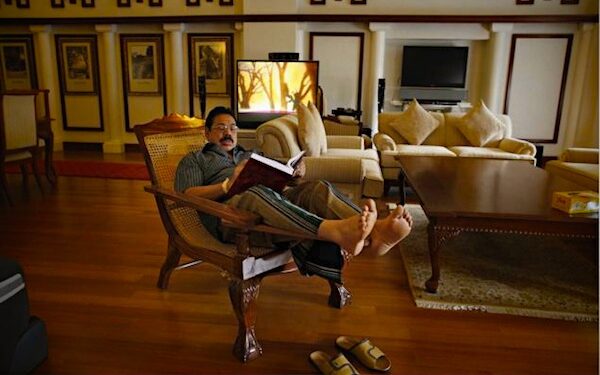
In a tragic tale of ancient luxury brought low by the barbaric concept of “public accountability,” former President Mahinda Rajapaksa has finally been banished from his palace, sorry, “official residence” at Colombo House. The man who once styled himself as the protector of the realm, slayer of Tigers, and unofficial CEO of the Rajapaksa Dynasty PLC, now finds himself downgraded to rural peasantry, surviving on that most savage of meals: sour fish stew.
“I travelled here via the Southern Expressway that I built,” he boasted, forgetting that the nation is still paying interest on the Chinese loan used to pave it. “Now I can enjoy a simple life in the village.” And by “simple,” he means surviving without a personal dog handler.
The Royal Eviction
According to the former president, his removal from Colombo House was nothing short of “political terrorism” and “personal revenge.” We reached out to several victims of actual political terrorism to gauge their reactions, but all we heard were confused laughs and sarcastic mutterings like “must be nice to be terrorized with a Rs. 4.6 million/month mansion.”
For years, Mahinda’s post-presidential career involved patriotic activities such as collecting government-funded dog handlers, chefs, mechanics, and medical personnel. That’s right, he had more electricians (26) than some districts have for the entire grid.
One source revealed: “If his house had broken down, he could’ve built a second one using just his staff.”
A Life of Service (To Himself)
Between 2017 and mid-2025, Rs. 231 million of public money was lovingly poured into maintaining Mahinda’s…ahem, dignity. It included 111 staff members. That’s not a retirement package, it’s a small army. And yet, despite being treated like the lost monarch of some forgotten empire, Mahinda claims he was “forced out” unfairly.
Naturally, the public agrees. Just kidding, they don’t.
The very people who took to the streets during the Aragalaya in 2022, demanding an end to economic decay, corruption, and the government being run like a family WhatsApp group, are the same ones now expected to shed tears because Mahinda’s chef-to-mouth ratio has dipped below aristocratic standards.
The Tragedy of the Sour Fish Stew
Once regarded as the great “Appachchi,” Mahinda’s legacy has been dramatically reduced to what can only be described as a metaphor served in a clay pot. “The sour fish stew,” he said, “reminds me of where I came from.”
Observers suggest it also reminds him of what happens when you’re evicted from your golden cage and forced to experience the rustic joys of normalcy. For the first time in decades, he may have actually seen a public toilet and he didn’t even get to inaugurate it.
Some say the sour fish stew is the most honest meal he’s had in years. Gone are the foie gras fundraisers and lobster diplomacy. Now it’s fermented fish and the quiet realization that maybe, just maybe, the nation didn’t want to pay for his third massage therapist anymore.
Mahinda vs. Reality: 0–1
Rajapaksa has accused President Anura Kumara Dissanayake (AKD) of lacking discipline and professionalism, which is ironic coming from a man whose economic strategy was reportedly based on the ancient principle of “print more money and hope for the best.”
Under AKD, a historic 151–1 parliamentary vote repealed the act that allowed former presidents to bathe in taxpayer funded luxury. Mahinda was that “1” in spirit, furiously sipping his stew, muttering about how discipline means nothing if your personal dog handler is taken away.
A Legacy of Missed Opportunities (and Overstaffed Kitchens)
Yes, Mahinda ended the war. Yes, he ruled with charisma. But he also mistook the national treasury for a family trust fund. Under his reign, the government operated like a nepotism theme park, with each ride more financially reckless than the last.
What did the people get? Rising debt, shrinking opportunities, and a long list of national projects that aged about as well as warm pol sambol.
What did he get? Rs. 231 million, nine doctors, a backup set of mechanics, and a dog handler. (Still unclear whether it was for the dog or for Namal.)
The Future: Humble Pie on the Menu
Now, as AKD’s government wipes out the final vestiges of executive indulgence, Mahinda faces the cold truth: the country has moved on. The people no longer want emperors, they want leaders. And leaders, in AKD’s era, ride budget tuk-tuks, not government-funded SUVs with sirens louder than their policies.
The sour fish stew, once a meal of the ordinary folk, has now become symbolic of a bitter, fermented end to a bloated political career. Where once he dined on state funded delicacies, now he chews on the realization that his legacy is less “hero of the people” and more “gentleman squatter with state funded staff.”
Epitaph of the Empire
In the end, Mahinda Rajapaksa will not be remembered for his military victory, or his expressways, or his epic messages. No, he will be remembered as the man who mistook privilege for service, and who saw accountability as revenge.
“History,” a villager whispered, “will not remember him as a king. It will remember him as a man who had 16 chefs and still served sour fish stew.”
Indeed, let it be known: Mahinda didn’t fall from grace.
He was evicted from it.
Editor’s Note: We tried to reach Mahinda Rajapaksa for comment. His spokesperson said he was unavailable, “still emotionally recovering from the loss of the in-house sushi chef.”