America Crosses a Rubicon: Strikes on Iran’s Nuclear Core Reshape the Middle East
For decades, U.S. administrations drew a clear red line: no direct military strikes on Iran’s nuclear infrastructure. The fear? Escalation into a full-blown regional war. That line has now been crossed.
In a dramatic shift, President Trump, who once called himself a “president of peace” has authorized precision airstrikes on Iran’s nuclear sites, including Natanz, Isfahan, and the ultra-hardened Fordow complex. The move is already being described as the most consequential military action of his second term.
Strategic Shock: The Targets and the Message
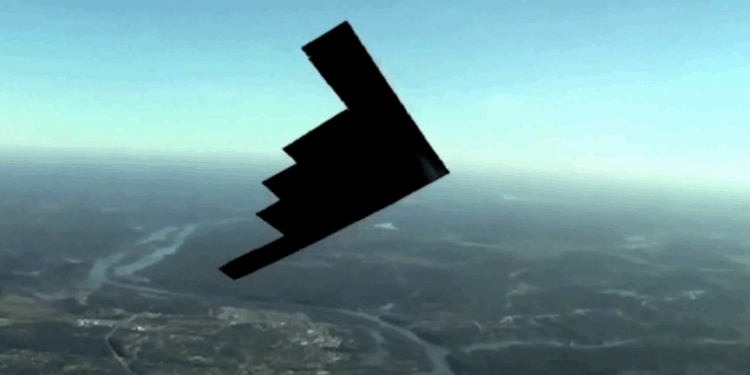
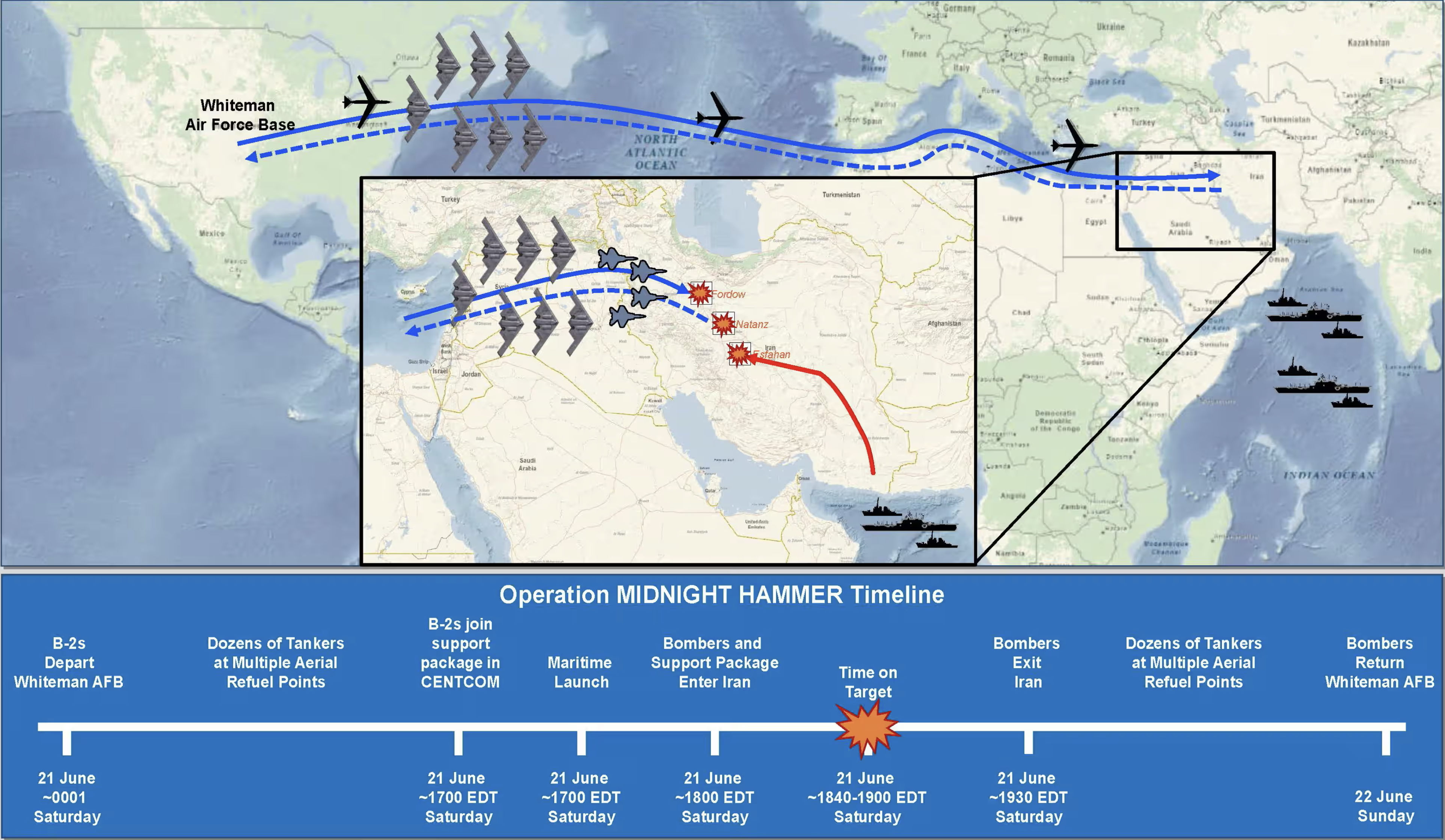
Flying from bases in Guam, U.S. B-2 stealth bombers delivered powerful bunker-busting munitions to penetrate Iran’s underground enrichment facilities. Fordow, buried 90 meters beneath solid rock, was long believed to be nearly invulnerable. No longer.
U.S. officials claim the damage is “severe.”
Independent analysts remain cautious, buried uranium stockpiles are hard to assess.
Natanz and Isfahan, also targeted, had previously sustained hits from Israeli operations. This U.S. strike dramatically raises the stakes.
Tehran in Crisis: Supreme Leader in Hiding
Iran’s Supreme Leader Ayatollah Ali Khamenei, now 86, is reportedly sheltering in a secure bunker. The symbolism is powerful and dangerous. His response could decide not just his legacy, but the fate of the Islamic Republic itself.
“This is not a war Iran wants,” says Hamidreza Aziz,
“But the regime can’t afford to appear weak.”
Sanam Vakil of Chatham House notes: “Khamenei faces his most consequential decision since the 1988 ceasefire with Iraq. His poisoned chalice may be even more potent.”
“Diplomacy was a pretext. This was deception—nothing more.”
— Iran’s Foreign Minister, Abbas Araghchi
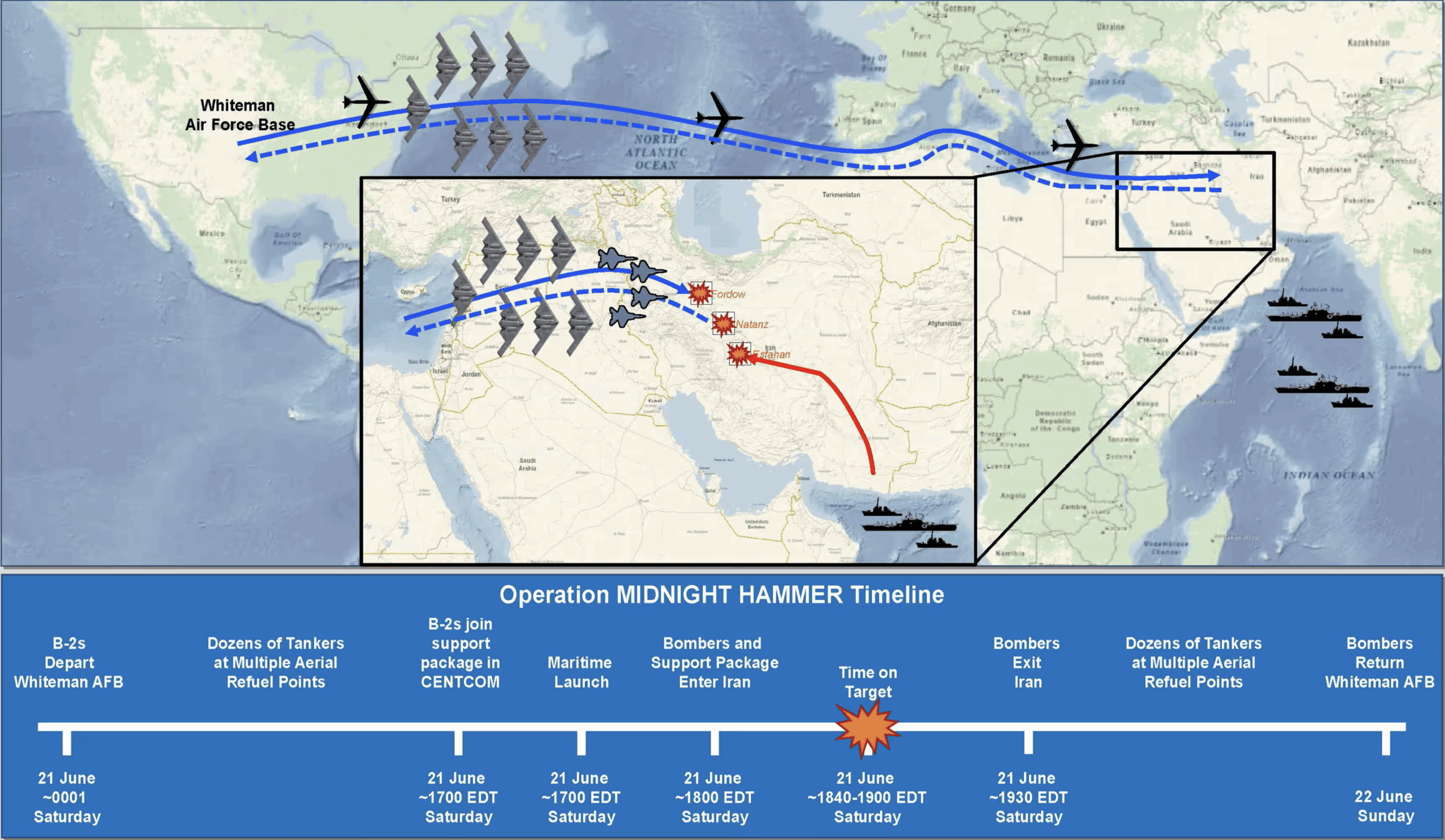
The timeline of Operation Midnight Hammer. Photograph: US Department of Defense.
Iran’s Next Move: Escalation or Strategic Patience?
Potential Options on Tehran’s Table:
- Direct attacks on U.S. forces in Iraq or the Gulf
Would provoke overwhelming U.S. retaliation. - Closing the Strait of Hormuz
Risks global oil market chaos and regional alienation. - Proxy warfare or missile launches
A familiar but weakened playbook, especially after recent Israeli campaigns.
So far, the Islamic Revolutionary Guard Corps (IRGC) has promised a response that will cause the U.S. “lasting regret” but insists it does not seek all-out war.
The End of Diplomacy?
The strikes come just as backchannel diplomacy, via indirect talks in Muscat, was reportedly nearing a breakthrough. With bombs now falling, diplomatic progress has stalled, possibly for good.
Iran accuses Washington of “weaponizing diplomacy.” Meanwhile, the Organisation of Islamic Cooperation, representing 57 Muslim nations has condemned the attacks and warned of grave consequences.
Europe’s Warning: “You May Be Making It Worse”
European leaders have pleaded for restraint. While united in opposition to a nuclear Iran, they worry that the current path will:
- Accelerate Tehran’s nuclear program, not deter it
- Shatter international trust in diplomacy
- Draw global powers into a broader confrontation
Ellie Geranmayeh of the European Council on Foreign Relations sums it up:
“This is the paradox. These strikes might harden Iran’s resolve to build the very weapon they’re meant to prevent.”
What’s at Stake for Both Nations?
For Iran:
- Legitimacy at home and abroad
- Control over a fractured proxy network
- The very survival of the Islamic Republic
For the U.S.:
- Risk of a long, costly conflict
- Collapse of fragile diplomatic alliances
- Potential blowback in an already volatile election year
President Trump, under mounting domestic pressure, claims the strikes are “a new path to peace.” Critics in Congress argue they are unauthorized and reckless, potentially dragging the U.S. into a war it has long sought to avoid.
Final Thought: The Line Is Gone
This isn’t just another crisis in the Middle East. It’s a paradigm shift, a Rubicon moment. Diplomacy has failed. Deterrence is being tested. And the world is watching.
Whether this leads to a new regional order or all-out catastrophe, may depend on what comes next.
Sometimes the most dangerous move isn’t action—it’s hesitation.