Enlightenment on an Empty Stomach: Three Monks Take on Sri Lanka’s Development Plans
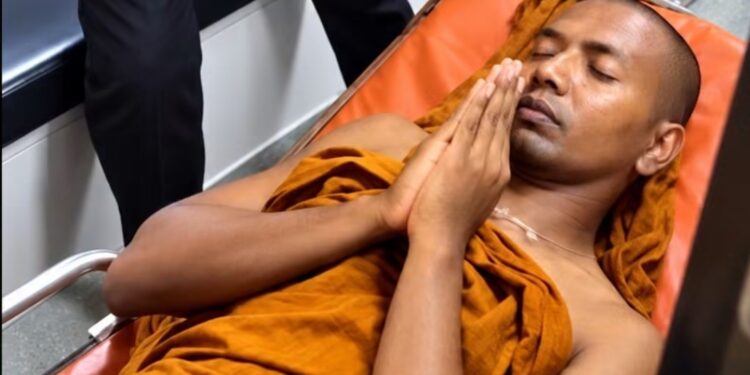
When spirituality meets town planning, even Nirvana appears to require government approval.
ANURADHAPURA, SRI LANKA — In a remarkable demonstration of how ancient spiritual traditions can collide with modern administrative complications, three Buddhist monks have launched a hunger strike in Sri Lanka’s historic city of Anuradhapura, demanding that the government withdraw its proposed redevelopment plan for the sacred area.
The monks, apparently convinced that enlightenment is best pursued without the distraction of urban planning, have decided to stop eating until their demands are met.
The government, meanwhile, insists that it is merely trying to improve roads, sanitation, transport and facilities for pilgrims and tourists. In other words, it wants to make visiting sacred places more comfortable, while the protesters fear that comfort may be the first step towards cultural catastrophe.
The proposed plan would expand the designated sacred zone from 28 to 38 square kilometres. Ten additional square kilometres have apparently become the latest battleground in the eternal struggle between preserving tradition and installing infrastructure.
In a country where politicians regularly promise development but struggle to deliver it, the government has somehow managed to provoke a protest over the prospect of actually developing something.
The Great Spiritual Real Estate Dispute
At the heart of the controversy are concerns about other religious places of worship potentially appearing within the expanded sacred zone.
A signboard identifying an archaeological site as a Kali Kovil has also become a source of anxiety.
Officials maintain that the remains belong to a historical structure dating back to the tenth century and that there is no evidence of newly constructed religious buildings.
But history, it seems, is not always welcome when it arrives with inconvenient archaeological evidence.
One wonders whether the ancient ruins have been consulted about their religious identity. After all, they have been standing there for centuries without apparently realising that they could one day become central characters in a modern political controversy.
Development: The New Enemy of Tranquillity?
The government says protective fencing will safeguard archaeological monuments and keep stray animals away.
The protesters, however, appear unconvinced.
Perhaps the concern is that once a fence goes up, the next thing will be a ticket counter, followed by parking fees, souvenir shops and eventually a five-star hotel offering a discounted meditation package.
Nothing threatens the peaceful atmosphere of an ancient pilgrimage site quite like the possibility of a tourist asking where the nearest washroom is.
The authorities insist that the development plan was prepared in consultation with religious leaders and government institutions. Yet, judging by the protests, consultation may have been interpreted differently by different parties.
In Sri Lanka, consultation sometimes seems to mean that everyone was invited to the meeting, but nobody agreed on what was discussed.
A Hunger Strike With a Shopping List of Demands
The three monks reportedly began their protest after lunch on Tuesday. Their demands extend beyond withdrawing the development gazette to include the release of another Buddhist monk, Galagodaatte Gnanasara, who has returned to prison to serve the remainder of a six-year sentence for contempt of court.
This gives the hunger strike an interesting administrative dimension.
What began as a dispute over sacred land has now become a package deal involving urban planning, religious identity, archaeology and the prison system.
One can only imagine the government department responsible for processing the demands.
Perhaps a new ministry will have to be established: the Ministry of Fasting, Sacred Land and Miscellaneous Spiritual Grievances.
The Search for Nirvana Continues
There is, of course, a serious question beneath the comedy.
Anuradhapura is one of Sri Lanka’s most important centres of Buddhist heritage, with a history stretching back more than 2,200 years. Its sacred monuments deserve protection, and concerns about preserving their historical and religious character deserve careful consideration.
At the same time, conservation, public infrastructure and religious coexistence need not necessarily be enemies.
A sacred city can have proper sanitation without losing its sanctity. Archaeological monuments can be protected without turning the surrounding community into prisoners of history. And different religious traditions can coexist without every ancient ruin becoming a national security issue.
Perhaps the real challenge is not finding the perfect development plan but developing the wisdom to disagree without turning every disagreement into a national confrontation.
The Buddha taught detachment from worldly desires. Sri Lanka’s current controversy suggests that detachment from political positions may be an even more difficult spiritual exercise.
For now, three monks are fasting, officials are explaining, protesters are protesting, and the government is trying to convince everyone that a fence is just a fence.
Meanwhile, somewhere in Anuradhapura, an ancient tree continues to grow peacefully, apparently the only participant in the entire controversy that has achieved enlightenment.
Moral of the story: The road to Nirvana may be paved with good intentions, but in Sri Lanka, it appears to require planning permission, archaeological clearance, a gazette notification and, occasionally, a hunger strike.