Alberta’s Heart Belongs to Canada: A Call for Unity, Hope and a Shared Future
As Alberta approaches a pivotal referendum, the province finds itself at a crossroads, not merely over a political question, but over the kind of future its people wish to build for themselves, their children and generations yet to come. With the final day of advance voting arriving amid fierce prairie winds, Albertans on both sides of the debate took to the streets to make their voices heard. Yet, beyond the flags, the speeches and the political disagreements, one powerful truth remains: Alberta’s future is about people, belonging and the bonds that hold a country together.
On Saturday, the winds swept through Calgary and Edmonton, challenging campaigners but failing to silence their convictions. The Alberta Federation of Labour cancelled its planned Okotoks rally because of the dangerous weather, while an independence rally outside Edmonton’s legislature began an hour later than scheduled. In Calgary, however, hundreds gathered outside City Hall before marching downtown in support of Canadian unity.
Their message was simple: Alberta can stand strong without standing alone.
A province built on hard work, kindness and belonging
Among the supporters at the Calgary rally was Barbara Bodugel, who travelled from Rocky Mountain House to show her support for Alberta remaining part of Canada. Her outfit, which she called the “cape of corruption,” was fashioned from political advertisements and mailers, expressing her frustration with the provincial government.
But beneath the political statement was something much more personal—a mother’s and grandmother’s concern for the future.
Bodugel explained that the choices made today would directly affect her children and grandchildren. She spoke of Alberta as a kind, accepting and welcoming province, and expressed her desire to preserve those values for future generations. As someone married to an immigrant, she said she did not want to see Alberta become a place where newcomers felt unwelcome.
Her words captured the heart of the stay-in-Canada movement. For many Albertans, this is not simply a debate about political power, natural resources or the division of responsibilities between governments. It is about the people who have built their lives here, the families who have put down roots, and the belief that diversity and cooperation make a province stronger.
Canada has never been perfect. Like every country, it has its disagreements, injustices and shortcomings. But its promise has always been that people from different backgrounds, regions and traditions can share a common home while retaining their identities and local pride.
Alberta has played a vital role in that national story. Its farmers, energy workers, teachers, health-care professionals, tradespeople, entrepreneurs and newcomers have helped shape the country’s prosperity. The province’s contribution to Canada is undeniable, and Canada’s place in Alberta’s story is equally significant.
A voice for the next generation
Alberta NDP Leader Naheed Nenshi joined the Calgary rally alongside several party MLAs, urging supporters to encourage everyone they know to vote. His message centred on participation, the importance of the ballot and the responsibility Albertans share in shaping their future.
The appeal was more than a campaign slogan. Democracy works best when people look beyond frustration and choose to participate constructively, even when the issues are difficult and opinions sharply divided.
For those who support remaining in Canada, the choice represents an opportunity to preserve economic connections, strengthen relationships with other provinces and continue working toward a country that serves all its people.
It also represents a commitment to future generations. Children and grandchildren deserve a future in which opportunity is not limited by political borders, where families can move freely across provinces, where businesses can reach customers throughout the country, and where differences are addressed through dialogue rather than separation.
The question is not whether Alberta should have a strong voice. It absolutely should. Albertans deserve to be heard in Ottawa, respected in provincial discussions and treated fairly in decisions that affect their livelihoods. But a strong voice within Canada may offer a more constructive path than breaking away from the country with which Alberta shares so much history, infrastructure, commerce and family connection.
Staying together does not mean agreeing on everything. It means believing that disagreements can be resolved without giving up on one another.
Treaty rights and the promise of a shared future
At the Calgary gathering, Piikani Nation Chief Troy (Bossman) Knowlton reminded the crowd of a fundamental part of Alberta’s history: Indigenous treaty rights predate the creation of the province itself.
His remarks brought an important dimension to a debate that can otherwise become narrowly focused on provincial and federal political disputes. Alberta’s future cannot be considered separately from the rights, histories and enduring presence of First Nations and other Indigenous peoples.
Canada’s relationship with Indigenous communities has been marked by profound injustice, broken promises and painful experiences. Those realities must never be dismissed or forgotten. Reconciliation requires honesty, accountability and meaningful action.
At the same time, the treaties that shape Alberta’s legal and historical foundations are not simply political documents to be set aside when governments change. They represent enduring relationships and obligations that must be respected in any discussion about the province’s future.
For many supporters of Canadian unity, remaining within the existing constitutional framework provides continuity and established legal institutions through which treaty rights can be defended. That does not eliminate the challenges ahead, nor does it guarantee justice without continued effort. It does, however, reinforce the importance of approaching any constitutional change with care, respect and a clear understanding of its consequences.
A future worth building is one in which Indigenous communities are not left uncertain about their rights, where treaty promises are honoured, and where every government understands that reconciliation is a responsibility—not a political convenience.
Respecting disagreement while choosing cooperation
Across Edmonton, independence supporters also gathered despite the fierce winds, waving Alberta flags and listening to speakers who argued that the province’s values and interests no longer align with those of the rest of Canada.
Their concerns should not be brushed aside. Many Albertans feel frustrated by federal policies, believe their province is not adequately understood, or worry that decisions made far away are limiting local opportunities. These feelings deserve to be heard and addressed with seriousness.
A united Canada cannot thrive if any province feels ignored, dismissed or taken for granted. National unity requires more than asking Albertans to remain. It requires listening to their concerns, treating their contributions fairly and finding practical ways to resolve disputes.
Yet frustration, however understandable, need not lead to separation.
There is room within Canada for Alberta to demand better federal policies, protect its economic interests, strengthen its provincial autonomy and insist on respectful treatment. There is room for vigorous disagreement, passionate debate and political change.
The challenge is to turn anger into progress rather than allow it to become a permanent divide between neighbours, friends and family members.
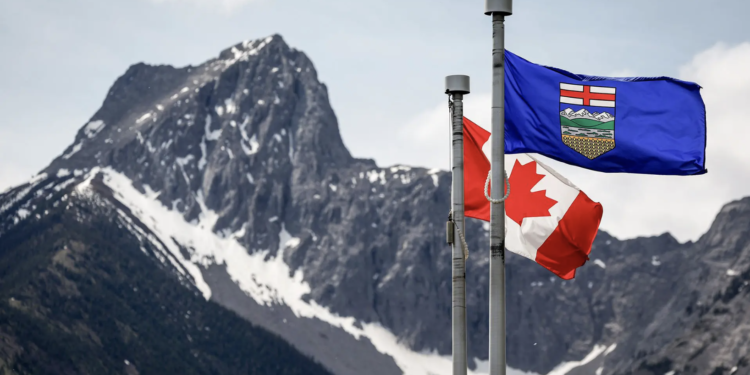
The flags seen in Edmonton and Calgary represented different visions of Alberta’s future. But the people holding them share many of the same hopes: secure jobs, affordable homes, good schools, accessible health care, thriving communities and a future in which their children can succeed.
Those common hopes offer a foundation on which Albertans can begin rebuilding trust, whatever the outcome of the referendum.
The meaning of home
For countless Albertans, Canada is not an abstract idea. It is a collection of memories and relationships.
It is the relative who lives in British Columbia, the friend who moved to Ontario, the family member who found work in Saskatchewan and the newcomer who chose Alberta as the place to begin again. It is the ability to travel across a vast country and still feel connected to a shared home.
It is also the understanding that a person’s identity need not be confined to one political boundary. An Albertan can be proud of the province’s landscapes, industries, traditions and independent spirit while also being proudly Canadian.
There is no contradiction in that identity.
Indeed, Alberta’s character—its determination, resourcefulness and willingness to take on difficult challenges—can be a source of strength for the entire country. Canada is stronger when Alberta is heard, respected and fully engaged in shaping the national future.
The answer to division is not to demand silence from those who disagree. It is to create a country in which disagreement leads to better decisions, where regional grievances are addressed, and where every province understands that its success is connected to the success of others.
A final choice for Alberta
As Albertans prepare to cast their ballots, the responsibility rests with each eligible voter to consider the arguments carefully, seek reliable information and make a decision grounded in both conviction and compassion.
The referendum may determine the direction of a political debate, but it will not erase the relationships that make Alberta what it is. Neighbours will still meet across their fences. Families will still gather around dinner tables. Coworkers will still depend on one another. Communities will still need people willing to listen, volunteer, teach, care and lend a helping hand.
Those everyday connections are the real foundation of a strong province.
For supporters of remaining in Canada, the message is ultimately one of hope: Alberta does not have to surrender its identity to remain part of the country. It can defend its interests, celebrate its distinct character and pursue a better future while continuing to share in the opportunities and responsibilities of a united Canada.
The prairie winds may have disrupted rallies and delayed speeches, but they could not extinguish the determination of people who believe their province’s future is best served through cooperation.
Now, as the final voting opportunity approaches, Albertans face a decision that reaches beyond the immediate political moment. It is a choice about how they wish to relate to their neighbours, how they want their children to understand belonging, and whether they believe a better future can be built together.
Alberta can be proudly Alberta and proudly Canadian. It can stand tall without standing apart.
In the end, the strongest country is not one without disagreements, but one whose people continue to believe that their differences can be overcome through respect, fairness and shared purpose.
For the sake of families, future generations and the enduring bonds that unite people from coast to coast, may Alberta choose a future rooted in cooperation, compassion and hope—a future in which its voice grows stronger, its people prosper, and its place in Canada remains a source of pride.
Because home is more than a place on a map. It is the people we stand beside, the promises we honour and the future we choose to build together.