Sri Lanka’s Rule of Law Tested as Court Overturns Pardon for Hardline Buddhist Monk
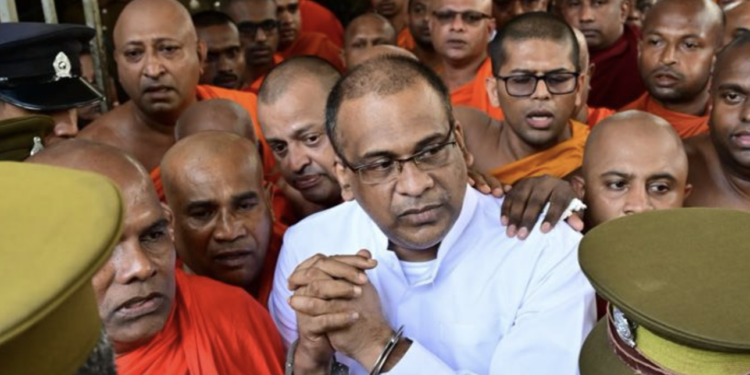
Gnanasara’s return to prison reignites debate over judicial independence, religious authority and political privilege, while President Anura Kumara Dissanayake insists that no individual is above the law.
Sri Lanka’s Supreme Court decision to invalidate the presidential pardon granted to controversial Buddhist monk Galagoda Aththe Gnanasara Thero has reopened a long-running debate over the rule of law, political influence and the relationship between religious authority and the state.
The ruling requires Gnanasara, the general secretary of the Bodu Bala Sena (BBS), or Buddhist Power Force, to serve the remainder of a six-year rigorous imprisonment sentence imposed in 2018 for contempt of court. The conviction arose from his conduct during court proceedings concerning the disappearance of journalist and political cartoonist Prageeth Eknaligoda.
Gnanasara was released in May 2019 after receiving a presidential pardon from then-President Maithripala Sirisena. The Supreme Court subsequently ruled that the pardon was unconstitutional and invalid, clearing the way for the enforcement of the outstanding sentence.
The case has become more than a dispute over the imprisonment of a Buddhist monk. It has raised fundamental questions about whether political connections and religious standing can shield individuals from judicial accountability, and whether the state can enforce prison regulations without being accused of interfering in religious affairs.
A case rooted in the disappearance of a journalist
At the centre of the original case is Prageeth Eknaligoda, whose disappearance in January 2010 remains a deeply sensitive issue in Sri Lanka.
Eknaligoda was known for political cartoons addressing media freedom, the exercise of political power and social inequality. His work was critical of former President Mahinda Rajapaksa, whose government led the country at the end of the civil war against the Liberation Tigers of Tamil Eelam in 2009.
Eknaligoda disappeared during the final years of Rajapaksa’s presidency and has not been seen since. His wife, Sanya Eknaligoda, has campaigned for answers about his fate and questioned the authorities’ handling of the investigation.
Gnanasara was convicted after interrupting proceedings at the Homagama Magistrate’s Court in support of military intelligence officials accused in connection with the journalist’s abduction. His conduct included intimidating Eknaligoda’s wife.
In 2018, the court convicted him on four counts of contempt of court and imposed a sentence of 19 years’ rigorous imprisonment, to run concurrently over six years.
He served less than a year before Sirisena granted the pardon.
The Supreme Court’s decision to invalidate that executive intervention has therefore revived a case closely associated with accountability for alleged abuses of state power and the protection of those seeking answers about enforced disappearances.
For Eknaligoda’s family, the case also underscores the continuing importance of ensuring that court proceedings related to the disappearance can take place without intimidation.
Presidential power and judicial independence
The invalidation of Gnanasara’s pardon has placed the limits of presidential authority under renewed scrutiny.
Presidential pardons are an important constitutional power, but they are not necessarily beyond judicial review. In this case, the Supreme Court’s decision means that the earlier executive intervention cannot stand, and the outstanding sentence must be enforced through the judicial process.
The development also comes amid President Anura Kumara Dissanayake’s public emphasis on the independence of the judiciary and the equal application of the law.
Addressing the Badulla District Women’s Conference, Dissanayake said no one should expect political intervention, special decisions or presidential pardons to overturn final judicial rulings or circumvent prison sentences.
He said the government would abide unconditionally by court decisions and would not provide avenues for individuals to evade punishment outside the judicial process.
The President argued that people who previously believed themselves protected from legal consequences were now facing the application of the law. He added that those who had enjoyed privileges and undue protection under the previous system were protesting as they realised that they, too, could be held accountable.
Dissanayake also outlined the distinct responsibilities of the institutions involved in criminal justice. Investigations are conducted by the police, the Criminal Investigation Department and the Commission to Investigate Allegations of Bribery or Corruption, while the Attorney General’s Department institutes legal proceedings. The courts, including the Supreme Court, are responsible for hearing cases and delivering judgments.
His remarks framed the Gnanasara case as part of a broader principle: once the judiciary has delivered a final ruling, the executive should not intervene to reverse it through political pressure.
The significance of that position extends beyond one prisoner. It concerns the constitutional boundaries between the executive and the judiciary and whether those boundaries are upheld consistently, regardless of an individual’s influence or public standing.
The prison uniform controversy
Gnanasara’s return to prison has generated a second controversy, this time over his appearance in court without his familiar saffron robes.
When prison officials produced him before the Colombo High Court on 6 October in connection with another case, he appeared in civilian or prison clothing rather than his customary Buddhist robes.
The change prompted Opposition Leader Sajith Premadasa to question the government’s handling of the matter.
Premadasa argued that the state should respect religious traditions and the dignity associated with the Buddhist robe. While acknowledging the importance of the legal framework, he maintained that government decisions should also take account of cultural conventions and religious identity.
He further argued that decisions about whether a person should retain the status of a Buddhist monk should be made by the relevant religious authorities. He called for sensitive matters involving Buddhist clergy to be handled in consultation with the Mahanayake Theras, the senior leaders of the Buddhist monastic establishment.
Premadasa’s intervention shifted public attention from the enforcement of the Supreme Court ruling to the treatment of a convicted prisoner who holds religious status.
The central question became whether Gnanasara had been singled out because he was a monk or whether prison authorities were applying existing regulations governing prisoners serving rigorous imprisonment sentences.
Government says prison regulations apply equally
The Prisons Department has rejected suggestions that Gnanasara was subjected to a special measure.
Commissioner of Prisons (Operations) and department spokesman Senaka Pallethenna explained that the clothing worn by prisoners when they appear in court is governed by prison regulations.
According to his explanation, a Buddhist monk serving a sentence of simple imprisonment may remain in robes. A monk sentenced to rigorous imprisonment, however, is required to wear prison clothing.
The department also distinguishes between prisoners according to the length of their sentences. Prison superintendents may permit some prisoners serving sentences of less than three years to wear the civilian clothing they wore before imprisonment. Those serving longer sentences must, under the stated procedure, appear in clothing issued by the prison.
Gnanasara’s six-year rigorous imprisonment sentence places him within the latter category.
The department has also stated that members of the clergy have previously served prison sentences under established legal and administrative procedures.
Cabinet spokesman and Minister Nalinda Jayatissa reinforced that position, saying that the relevant provisions of the Prisons Ordinance and prison regulations were being applied without a special procedure for Gnanasara.
Jayatissa said the same approach applied to 63 Buddhist monks serving prison sentences. Gnanasara, he maintained, would receive neither exceptional treatment nor special privileges.
These explanations provide the government’s stated legal basis for the decision. Whether the regulations have been applied consistently in every relevant case remains a question that should be assessed against the applicable rules and their implementation, rather than political claims alone.
Prison clothing is not necessarily religious disrobing
A separate issue has emerged within the Buddhist establishment over the authority to determine the religious status of an ordained monk.
The Kotte Sri Kalyani Samagri Dharma Maha Sangha Sabha has argued that decisions about whether a monk should retain or remove his robes are matters for the relevant ecclesiastical authority.
That position raises an important distinction between the state’s authority over a convicted prisoner and the religious institution’s authority over its members.
Requiring an individual to wear prison-issued clothing while serving a sentence does not, by itself, necessarily amount to formally expelling that person from the Buddhist monastic order or declaring that he has ceased to be a monk.
The prison authorities say they are enforcing regulations governing custody and court appearances. Religious authorities, meanwhile, are asserting their role in determining monastic status.
Premadasa has emphasised the need to respect religious traditions, while the government has maintained that the prison rules apply equally to all prisoners covered by them.
These positions are not automatically incompatible. The state can enforce a lawful prison sentence while religious institutions retain authority over internal ecclesiastical matters. The difficulty arises when the distinction between administrative treatment and religious status becomes blurred in political debate.
A controversial political and religious legacy
Gnanasara’s prominence makes the controversy particularly sensitive.
As the leader of the Bodu Bala Sena, he became a prominent figure in Sinhala Buddhist nationalist politics and supported Mahinda Rajapaksa and his brother Gotabaya Rajapaksa, who later served as president.
The BBS has been associated with hardline positions on religious identity and minority communities. Gnanasara himself received a separate nine-month prison sentence in 2025 for insulting Islam and inciting religious hatred.
His legal history has therefore extended beyond the contempt-of-court conviction that originally led to his imprisonment.
Sri Lanka has a political and social tradition in which Buddhist monks hold significant public influence. Convictions resulting in imprisonment for members of the clergy are uncommon, making cases involving prominent monks particularly consequential.
However, religious standing does not automatically resolve the legal questions surrounding a conviction, a presidential pardon or the enforcement of a sentence. Nor does imprisonment, in itself, settle the separate question of a person’s standing within a religious institution.
The challenge for public institutions is to maintain these distinctions while ensuring that the law is applied consistently.
Court of Appeal proceedings add another dimension
The legal proceedings surrounding Gnanasara’s imprisonment have also prompted a separate dispute over the removal of his robes.
Court of Appeal President Justice Rohantha Abeysuriya recused himself from the bench considering petitions seeking to quash the prison authorities’ decision to remove the robes of the imprisoned monk.
Following his recusal, he appointed a new three-judge bench comprising Justices Amal Ranaraja, Mahen Gopallawa and Priyantha Fernando to consider the petitions.
The proceedings introduce a further judicial question concerning the legality of the prison authorities’ action. They also demonstrate that objections to administrative decisions can be brought before the courts rather than resolved solely through political statements.
The outcome of those proceedings will be important in clarifying the legal relationship between prison regulations, the rights of convicted prisoners and claims concerning religious identity.
It is important, however, to distinguish this dispute from the Supreme Court ruling invalidating the presidential pardon. The former concerns the treatment of Gnanasara in custody; the latter concerns the constitutional validity of the executive decision that had released him from his sentence.
The wider implications for Sri Lanka
The Gnanasara case brings together several of Sri Lanka’s enduring political challenges: the legacy of the civil war, unresolved questions about enforced disappearances, the influence of religious nationalism, and public confidence in the independence of state institutions.
For families seeking answers about missing relatives, the case highlights the importance of protecting court proceedings from intimidation and ensuring that allegations involving state officials receive due process.
For the government, the enforcement of the outstanding sentence provides an opportunity to demonstrate that judicial decisions apply regardless of political connections or religious status. That principle, however, depends on consistent implementation across cases, not merely on statements by political leaders.
For the opposition, Premadasa’s intervention raises questions about how the state should balance the rights and dignity of prisoners with the traditions of religious institutions. Those concerns can be examined without treating a prison clothing rule as automatically equivalent to religious persecution.
For the Buddhist establishment, the dispute presents a question about how its authority over monastic discipline interacts with the state’s legitimate responsibility to administer imprisonment under the law.
Ultimately, the issue is not simply whether a prominent monk should wear saffron robes or prison clothing. It is whether legal obligations, religious authority and political influence can be kept within their proper constitutional and institutional boundaries.
President Dissanayake has argued that no one should be able to escape a final judicial decision through political intervention. The Supreme Court’s invalidation of Gnanasara’s pardon gives that principle a concrete test.
The credibility of the rule of law will depend not only on whether the sentence is enforced in this case, but also on whether the same standards are applied impartially to others, whether judicial decisions remain free from political pressure, and whether the rights of those seeking justice including the family of a missing journalist are protected.
Sri Lanka’s institutions now face the task of resolving the remaining disputes through lawful procedures, while resisting attempts to turn questions of judicial accountability and prison administration into contests of political or religious loyalty.