Namal and the Miracle of the Five-Hour Appointment
There are many ways to spend a Thursday morning. You can have breakfast, you can go for a walk. You can attend a political rally and explain how everyone else is corrupt.
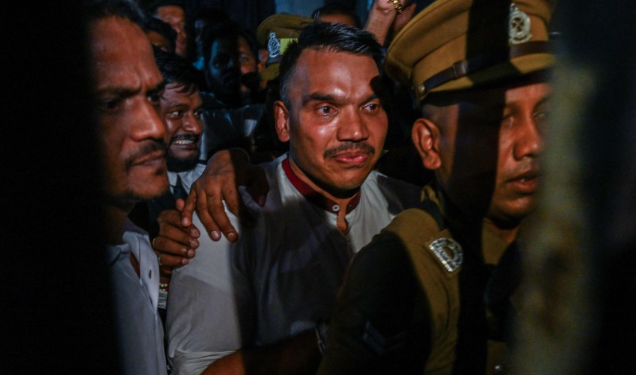
Or, if you are Namal Rajapaksa, you can finally answer a summons from the bribery commission and discover that the phrase “come in for questioning” can have a surprisingly literal ending.
According to investigators, Namal Rajapaksa was summoned to appear before Sri Lanka’s Commission to Investigate Allegations of Bribery or Corruption on September 4.
This was not, apparently, his first invitation.
The commission had reportedly summoned him in July.
He didn’t show.
It summoned him again in August.
He still didn’t show.
Then came the WhatsApp message: please attend, or we may seek a court order.
He attended.
Five hours later, he was arrested.
One can only imagine the disappointment of everyone who had been hoping for a fourth postponement.
The Appointment That Went Off the Rails
The allegations are serious. Investigators allege that Rs. 100 million was paid to Rajapaksa in connection with the procurement of Airbus aircraft for SriLankan Airlines.
The alleged money trail involves millions of euros, offshore companies, Singaporean bank accounts and a businessman who investigators say provided evidence about payments allegedly made to Rajapaksa.
This is the sort of financial story where even the flowchart eventually needs a flowchart.
According to the allegations presented in court, approximately €1.45 million entered a Singapore account belonging to Biz Solutions Inc. Investigators say US$800,000 was subsequently transferred to an account belonging to Sabre Vision Holdings Ltd., associated with businessman Nimal Perera.
Investigators further allege that the money was converted into Sri Lankan rupees and handed to Rajapaksa in installments during 2014 and 2015.
Rajapaksa denies the allegations, and his lawyers have challenged the evidence and the credibility of the businessman whose testimony is central to the allegation that the money reached him.
That distinction matters.
Because alleged bribery is an allegation, not a conviction.
But there is another distinction worth making:
A political career built around confidently accusing everyone else of wrongdoing becomes somewhat less comfortable when investigators start asking questions about you.
Welcome to the Airbus Family
The aircraft deal itself belongs to that remarkable period of Sri Lankan governance when apparently everything was simultaneously enormous, complicated and somehow nobody’s responsibility.
SriLankan Airlines entered into a contract reported at around Rs. 290 billion for 12 Airbus aircraft.
The transaction has since become part of an international corruption investigation.
And somewhere along the way, according to investigators, money allegedly travelled through companies whose names sound as though they were generated by an offshore-company-name generator:
Biz Solutions Inc.
Sabre Vision Holdings Ltd.
One almost expects the next entity to be called Definitely Not A Bribe Holdings (BVI) Ltd.
Unfortunately, the investigators appear to have taken the paperwork more seriously.
The Rajapaksa Doctrine of Political Gravity
For years, Sri Lankan politics operated according to a remarkably simple physical principle:
Everything eventually came back to the Rajapaksas.
Government ministries?
Rajapaksas. Airlines? Rajapaksa connections. Presidential power? Rajapaksas. Parliament? Rajapaksas. Political rallies? Rajapaksas. Investigations? Eventually, also Rajapaksas.
The remarkable thing about Namal’s current predicament is therefore not that his name has appeared in a corruption investigation.
It is that investigators have apparently decided to keep following the money after it passes through the usual collection of intermediaries, businessmen and corporate structures.
That is an unusually adventurous concept in Sri Lankan public life.
The Old Political Magic Trick
For years, Sri Lankan governments performed a familiar magic trick.
They would announce an investigation.
There would be dramatic press conferences.
Police would arrive somewhere.
Someone would be questioned.
Someone might be arrested.
Television channels would spend three days discussing the case.
Then time would pass.
A new government would arrive.
The political alliances would change.
And suddenly the investigation would be suffering from a mysterious condition known locally as “further investigations are ongoing.”
This was Sri Lanka’s accountability system:
Now you see the suspect.
Now you don’t.
Now he’s your coalition partner.
The great achievement of the old political establishment was not necessarily proving that politicians were innocent.
It was making accountability so slow, complicated and politically negotiable that everyone eventually became tired.
The UNP’s Sudden Discovery of Civil Liberties
Then came one of the more amusing developments.
The UNP, once among the Rajapaksas’ most determined political opponents, criticized Namal’s arrest and raised concerns that it could be politically motivated.
This is politics at its most wonderfully circular.
Years ago, the Rajapaksas were portrayed by their opponents as the embodiment of everything wrong with Sri Lankan governance.
Then the political winds changed.
The Rajapaksas lost power.
Gotabaya left office.
Ranil Wickremesinghe became president with parliamentary support from the very political forces that had once been his principal adversaries.
And suddenly everyone discovered that yesterday’s political monster could make a perfectly respectable ally today.
Sri Lankan politics has never really believed in enemies.
It believes in temporary seating arrangements.
The Rally That Acquired a Legal Footnote
The SLPP reportedly had a political rally planned under Namal’s leadership.
Then Namal was arrested.
Naturally, the party saw political motives.
This is understandable.
Politicians are extremely sensitive to coincidences — particularly coincidences that interfere with their rallies.
But there is another possibility:
Perhaps a bribery investigation really is a bribery investigation.
Perhaps the commission really was investigating an alleged Rs. 100 million payment.
Perhaps investigators really did follow banking records and international evidence.
And perhaps the timing is simply the timing.
The courts will have to sort out the difference.
That is what courts are for.
Politicians, meanwhile, have another job:
Explaining why the timing of every investigation involving themselves is suspicious while the timing of every investigation involving their opponents is miraculous.
The $800,000 Question
The most important issue is not whether Namal’s political opponents are celebrating.
They are.
Nor is it whether his political allies are outraged.
They are.
The question is whether the prosecution can establish the alleged chain:
Airbus-related payments, intermediary companies, businessman, cash conversion, alleged payments to Namal.
That is where the case will ultimately live or die.
Not on television.
Not at rallies.
Not on Facebook.
Not in speeches about conspiracies.
And certainly not on WhatsApp.
Evidence will have to do the heavy lifting.
Rajapaksa’s lawyers have already challenged the credibility of key evidence, including the testimony of the businessman alleged to have delivered the money.
That challenge deserves to be tested through the legal process.
If the evidence does not establish the allegation, the allegation should fail.
If it does, then the courts will have to deal with the consequences.
Either way, shouting louder won’t alter the bank statements.
Sri Lanka’s Favourite Family Reunion
There is something almost poetic about an Airbus investigation bringing together so many familiar characters from the Rajapaksa era.
Politicians.
Airline executives.
Businessmen.
Offshore companies.
Foreign bank accounts.
International investigators.
Political parties that once promised to destroy each other.
And now, years later, a Rajapaksa family member sitting in remand custody while lawyers argue over bail.
If someone had pitched this as a television drama in 2010, viewers would have complained that the plot was unrealistic.
In Sri Lanka, apparently, it was merely the next season.
The Real Satire
The easiest joke is to mock Namal.
And there is plenty of material.
Three summons.
One WhatsApp warning.
Five hours of questioning.
One arrest.
A Rs. 100 million allegation.
An Airbus.
Singapore.
Australia.
France.
A businessman.
A collection of companies with suspiciously reassuring names.
It practically writes itself.
But the bigger joke is Sri Lanka’s political system.
Because the country has spent years watching politicians promise to prosecute corruption, only for the political map to change before the prosecution reaches the destination.
The old enemies become allies.
The allies become enemies.
The investigations change hands.
The rhetoric changes.
The slogans change.
The faces on the campaign posters change.
And somehow the alleged money keeps turning up in the same general neighbourhood.
So perhaps Namal’s greatest misfortune is not merely that the bribery commission finally came knocking.
It is that, for once, someone appears to have answered the door.
Now comes the boring part.
Evidence.
Bank records.
Witnesses.
Documents.
Cross-examination.
Due process.
And a court deciding what can actually be proved.
For a political culture accustomed to settling everything with rallies, television interviews and accusations of conspiracy, that may be the most radical development of all.
The politicians can tell the story.
The lawyers can argue the story.
The newspapers can mock the story.
But eventually, somebody has to prove the story.