Petition to Expel U.S. Ambassador Pete Hoekstra Draws More Than 171,000 Signatures in Canada
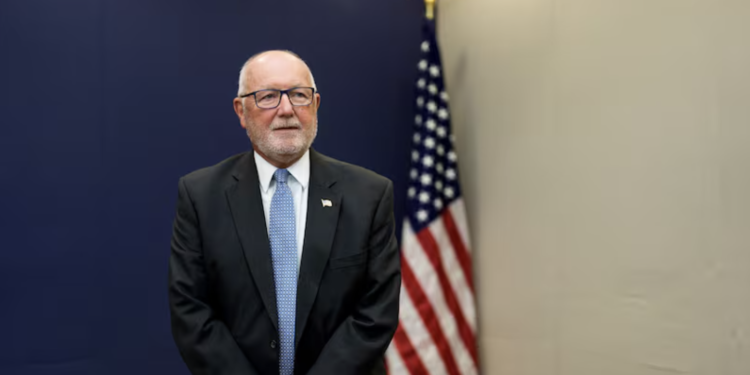
A petition calling for the expulsion of U.S. Ambassador to Canada Pete Hoekstra has attracted more than 171,000 signatures, highlighting growing frustration in Canada over the policies and rhetoric of U.S. President Donald Trump’s administration.
The official petition before Canada’s House of Commons had surpassed 171,000 signatures by Saturday, far exceeding the 500-signature threshold required for a petition to be formally presented to Parliament. Once that threshold is reached, the Canadian government is required to provide an official response within 45 days.
The petition accuses Hoekstra of repeatedly making public statements that undermine Canada-U.S. diplomatic relations. It calls on the Canadian government to formally declare him persona non grata and request that Washington remove him as ambassador.
Hoekstra has defended Trump’s controversial proposal to make Canada the “51st” U.S. state. He also came under criticism last year after accusing Canadian officials of attempting to interfere in U.S. elections.
Those comments followed advertisements funded by the Ontario government criticizing Trump’s tariff policies, which have placed significant pressure on Canadian trade. Hoekstra warned at the time that Canada could not expect there to be “no consequences or reaction” from the United States over the campaign.
The petition also raises questions about reported connections between Hoekstra and the founder of an application that has been used by separatists in Calgary to mobilize support for their movement. Hoekstra has previously rejected allegations of ties between the Trump administration and Canadian separatist groups.
Three Demands
The petition sets out three principal demands for the Canadian government.
First, it asks the House of Commons to formally declare Hoekstra persona non grata and request his removal as U.S. ambassador to Canada.
Second, it calls for cross-border discussions concerning what the petition describes as a pattern of conduct by Hoekstra that is inconsistent with the Vienna Convention on Diplomatic Relations, the 1961 international treaty governing diplomatic relations between states.
Third, it calls for a parliamentary committee to investigate alleged U.S. diplomatic interference in Canadian domestic affairs.
The petition was authorized by Elizabeth May, leader of the Green Party and its only current member of the House of Commons, after Calgary resident Leanne Walker submitted the initiative.
Under Canadian parliamentary rules, citizens can organize petitions calling attention to issues they want the House of Commons to consider. Participants must provide their province or territory, postal code and telephone number. Petitions can remain open for as long as 120 days.
The Hoekstra petition was introduced on July 21.
Despite its enormous level of support, the petition is not legally binding. Crossing the 500-signature threshold guarantees parliamentary consideration and an official government response, but it does not require Parliament to adopt any of the petition’s demands. It therefore remains uncertain whether the initiative will translate into concrete action against Hoekstra.
A Broader Breakdown in Relations
The petition’s popularity nevertheless offers another indication of the deterioration in Canadian public sentiment toward the Trump administration.
Relations between the two North American neighbors have been strained by disputes over trade, tariffs and sovereignty. Trump has repeatedly threatened Canada with additional tariffs while promoting a vision of expanded U.S. influence across the Western Hemisphere.
In July, Trump imposed new 50 percent tariffs on certain Canadian goods, citing what he described as “discriminatory treatment” in trade relations.
Canada responded by cancelling a planned celebration ceremony for the new Gordie Howe International Bridge, which connects Windsor, Ontario, with Detroit, Michigan. The future of the bridge itself had faced uncertainty after Trump pressed for a greater U.S. role in the project, which was jointly undertaken by Michigan and Canada.
Trump also threatened additional tariffs in response to wildfires in Canada, blaming Canadian conditions for poor air quality in parts of the United States.
The disputes have contributed to a sharp decline in Canadian confidence in the United States as a reliable partner.
A Pew Research survey conducted in June found that 35 percent of Canadians viewed the United States as reliable in 2026, compared with 83 percent in 2022. At the same time, the share of Canadians describing the United States as “not reliable” rose dramatically, from 16 percent in 2022 to 65 percent this year.
The petition targeting Hoekstra is therefore more than a dispute over one ambassador. Its extraordinary signature count reflects a broader deterioration in Canadian attitudes toward the United States and growing concern over Washington’s approach to its closest neighbor.
Whether Parliament ultimately takes action against Hoekstra remains uncertain. But with more than 171,000 Canadians having signed the petition, the message to Canada’s political leadership is difficult to ignore: a significant segment of the Canadian public is demanding a stronger response to what it sees as increasingly confrontational U.S. policy and diplomatic conduct.