Time for European Sovereignty as US Commitment Wavers
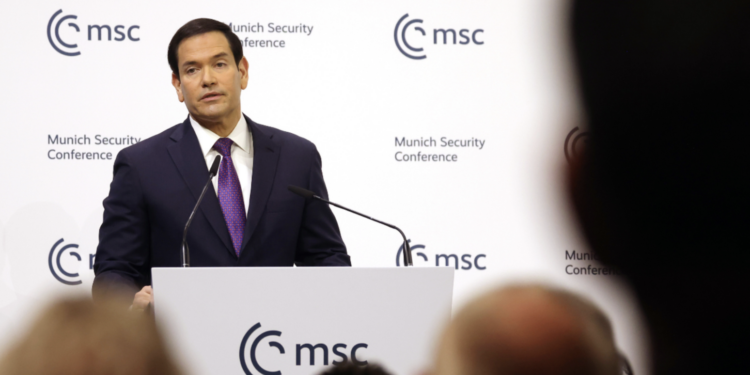
Tensions simmered beneath the diplomatic polish at this year’s Munich Security Conference, where Marco Rubio sought to reassure European allies that the United States and Europe share what he called an “intertwined destiny.”
But according to Fabrice Pothier, the speech was far from a conciliatory gesture.
In an interview with Euronews’ flagship morning programme Europe Today, Pothier, a former NATO Director of Policy Planning and now CEO of Rasmussen Global dismissed the notion that Rubio’s rhetoric amounted to an “olive branch.” Instead, he described it as a moment of “calm before the next tempest” in a transatlantic relationship that has grown increasingly fraught.
A Softer Tone, Not a Strategic Shift
Pothier argued that Rubio’s change in tone should not be mistaken for a substantive policy reset. “It is just a way to make the past few months a bit less painful,” he said, suggesting that European leaders are unlikely to be swayed by warmer language alone. “Europeans are not naive.”
Since the return of Donald Trump to the White House, historic ties between Washington and Brussels have come under renewed strain. A recent U.S. national security strategy accused European institutions of imposing “anti-democratic restrictions” and warned of a “stark prospect of civilizational erasure” on the continent language that has raised eyebrows in European capitals.
For critics, however, Rubio’s remarks in Munich went further than strategic divergence. They argue that his references to “European cultures” and “strong Christian values” echoed themes also heard in Trump’s address to the World Economic Forum in Davos, themes that, in their view, flirt with cultural exclusion and identity politics.
Some analysts contend that such language risks reinforcing narratives that portray Western identity in narrow civilizational or religious terms, implicitly marginalising immigrants and religious minorities. While supporters frame this rhetoric as a defence of heritage and sovereignty, detractors see in it undertones of xenophobia and a troubling willingness to blur the line between cultural pride and cultural hierarchy.
They also criticise what they describe as a muted response from major media outlets and European leaders, arguing that the broader ideological implications of this messaging have not been sufficiently scrutinised. References to protecting “Western civilisation,” critics warn, can easily slide into exclusionary interpretations if left undefined.
Rubio’s own biography has also been drawn into the debate. As an American of Cuban descent, he has long emphasised the importance of national identity and conservative values. Opponents argue that his alignment with Trump’s political project demonstrates the degree to which ideological loyalty within the administration transcends personal background, a reflection, they say, of the administration’s disciplined and centralised messaging strategy.
Deep Policy Divides Remain
Beyond rhetoric, substantive disagreements persist. “The road ahead is still made of many differences,” Pothier warned, pointing to Russia’s war in Ukraine as a central fault line. While European governments continue to frame support for Kyiv as an existential security imperative, divisions have emerged over the scope and long-term objectives of Western backing.
Another flashpoint is Greenland. President Trump’s revived interest in the Arctic territory, an autonomous region within the Kingdom of Denmark has unsettled European leaders. According to Pothier, there is “a mismatch” between the negotiated, diplomatic approach pursued by Copenhagen and Nuuk, and Trump’s more transactional ambitions.
“The US president takes a very emotional view; he just wants to own that piece of estate,” Pothier said. “He is thinking like a Manhattan real estate mogul.”
Europe’s Strategic Crossroads
For a growing number of European policymakers and commentators, the cumulative effect of these tensions points to a larger conclusion: Europe must accelerate efforts to build sovereign capabilities in defence, technology and energy, regardless of who occupies the White House.
This does not imply a rupture with NATO. On the contrary, proponents argue that greater European autonomy would strengthen the alliance by creating a more balanced and credible partnership. There is no inherent contradiction, they insist, between becoming more self-reliant and remaining a committed NATO ally.
If anything, enhanced European capacity could command greater respect in Washington and help stabilise a relationship that increasingly appears transactional and volatile.
Rubio’s invocation of shared destiny may resonate symbolically. But as Pothier’s assessment and the broader debate suggest, symbolism alone cannot repair widening strategic and ideological gaps.
For Europe, the message from Munich may ultimately be less about reassurance and more about realism: staying engaged with the United States remains essential but waiting for Washington to define the future of the West is no longer a viable strategy.