Trump’s Greenland Gambit: Tariffs, Territory and a Transatlantic Rift
US President Donald Trump has reignited one of the most controversial ideas of his political career: acquiring Greenland. This time, however, the ambition comes with a sharper edge. Trump has threatened escalating tariffs on several European countries that oppose his push to take control of the vast Arctic island, dramatically raising tensions between Washington and its NATO allies.
In a post on his Truth Social platform, Trump accused Denmark and other European states of benefiting for “centuries” from US protection and favourable trade terms. He announced that beginning February 1, Denmark, Norway, Sweden, France, Germany, the United Kingdom, the Netherlands and Finland would face a 10 percent tariff on all exports to the United States. By June 1, that tariff would rise to 25 percent and remain in place, Trump said, until a deal is reached for the “complete and total purchase of Greenland”.
Framing the issue as a matter of global security, Trump claimed that “China and Russia want Greenland” and argued that Denmark is powerless to stop them. “The National Security of the United States, and the World at large, is at stake,” he wrote.
A long-standing, controversial ambition
While Trump’s rhetoric is unusually blunt, his interest in Greenland is not unprecedented. The United States has eyed the island for more than a century. After purchasing Alaska from Russia in 1867, Secretary of State William H. Seward explored the possibility of buying Greenland, though the idea went nowhere. During World War II, the US occupied Greenland following Nazi Germany’s invasion of Denmark, building military and radio facilities that cemented America’s strategic presence in the region.
That presence continues today at the Pituffik Space Base in northwestern Greenland. In 1946, President Harry S. Truman secretly offered Denmark $100m for the island, an offer Copenhagen rejected. The proposal only became public decades later.
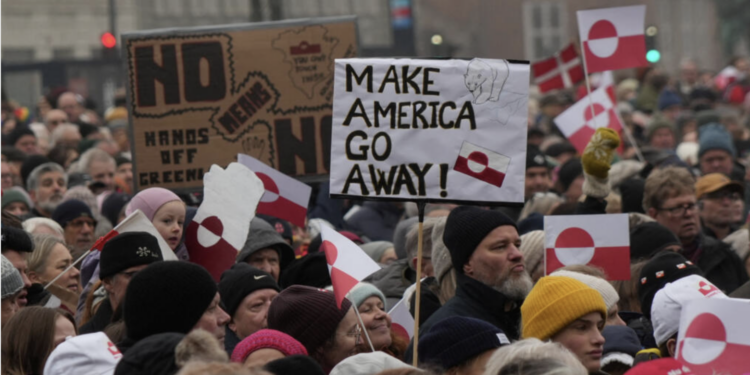
Trump revived the idea during his first term, drawing ridicule and firm rejection from both Denmark and Greenland’s leaders. Those positions have not changed. Greenland is a semiautonomous territory within the Kingdom of Denmark, and its leaders have repeatedly insisted that it is not for sale. In recent days, protests have broken out in Greenland against Trump’s renewed push.
Public opinion in the United States also appears unsupportive. A recent Reuters/Ipsos poll found that fewer than one in five Americans back the idea of acquiring Greenland.
Why Greenland matters
Despite the opposition, Greenland’s strategic value is undeniable. Geographically part of North America, the island sits between the Arctic and North Atlantic oceans and occupies a crucial position along the shortest air and sea routes between North America and Europe. Its capital, Nuuk, is closer to New York than to Copenhagen.
For the US military, Greenland is vital for missile early-warning systems and for monitoring activity in the Greenland-Iceland-UK gap, a key corridor for Russian and Chinese naval and air movements. As climate change opens Arctic waters, interest from major powers has intensified.
Greenland is also rich in minerals, including many classified by the European Union as “critical raw materials”. However, oil and gas extraction is minimal, and large-scale mining projects face resistance from Indigenous Inuit communities. The local economy remains heavily dependent on fishing.
Europe pushes back
Trump’s tariff threat has triggered a swift and coordinated response in Europe. All 27 EU member states are set to hold an emergency meeting to discuss their next steps, underscoring the seriousness with which Brussels views the dispute.
UK Prime Minister Keir Starmer reaffirmed Britain’s support for Denmark, stating that Greenland’s future “is a matter for the Greenlanders and the Danes”. He criticised the use of tariffs against allies, calling it incompatible with the spirit of NATO’s collective security.
European Commission President Ursula von der Leyen warned that tariffs would “undermine transatlantic relations and risk a dangerous downward spiral”, stressing EU unity and solidarity with Denmark and Greenland. EU foreign policy chief Kaja Kallas argued that the only beneficiaries of such divisions would be China and Russia, adding that tariffs would make both Europe and the United States poorer.
Dutch Foreign Minister David van Weel was even blunter, describing Trump’s approach as “blackmail” that weakens NATO rather than strengthening it.
A high-stakes confrontation
Trump’s Greenland gambit brings together trade policy, national security and great-power competition in a way that deeply unsettles America’s closest allies. By tying tariffs directly to territorial demands, he has crossed a line that many in Europe see as coercive and destabilising.
Whether the pressure forces concessions or hardens resistance remains to be seen. What is clear is that Greenland, remote, sparsely populated and often overlooked, has become the focal point of a dispute that could reshape transatlantic relations at a moment of growing global uncertainty.