Disaster as a Political Reset: Opening Doors of Hope in the Malaiyagam
History shows that disasters, while inflicting immense suffering and destruction, often function as political and social “reset buttons.” They disrupt entrenched power structures, challenge long-standing norms, and create rare “windows of opportunity” for reform, innovation, and reorganization. This idea is now widely framed as “building back better” not merely restoring what was lost, but rebuilding in fairer, more sustainable, and more dignified ways.
The devastation caused by the Ditwa Cyclone and the subsequent floods has pushed the Malaiyagam into such a historic moment. The disaster has ravaged the entire country, but its impact on the plantation regions has been particularly severe. Estates have been destroyed, livelihoods shattered, and alarming deep “splits” in the earth have appeared in several plantation areas. Against this backdrop, a troubling question has surfaced: Can people continue to live in the Malaiyagam at all?
This question has forced a re-examination of long-standing demands by Malaiyagam people, particularly those related to land and housing rights. Yet, amidst the destruction, a silver lining has begun to emerge. The disaster has unexpectedly triggered political and administrative shifts that were previously unimaginable.
Relief Distribution and a Shift in Malaiyagam Politics
In the past, disaster relief in the Malaiyagam was synonymous with political manipulation. National and provincial politicians, whether from ruling parties or the opposition—along with the so-called local estate leader, the “Thalaiwar,” ruthlessly intervened in relief processes. This Thalaiwar, usually a trade union leader aligned with a Malaiyagam political party, functioned as an all-powerful middleman. Without his consent, nothing could be done in the estates.
During the COVID-19 crisis, when the government announced a Rs. 5,000 relief grant, chaos erupted in many estates. Police and even riot squads were summoned to control angry residents protesting corruption, nepotism, and political interference. Government-sponsored relief materials including dry rations and rice donated by the Indian government were embezzled by political henchmen. Government officers such as Grama Niladharis (GNs) and Development Officers (DOs) were unable to function independently. Many, especially women officers, worked under extreme psychological stress. At the same time, the absence of accountability created fertile ground for large-scale corruption, with corrupt politicians serving as “role models.”
As a result, the Malaiyagam people came to view the state not as a service provider but as a hostile mechanism. This perception has deep political and social consequences, eroding trust in public institutions and democratic governance.
A Remarkable Turnaround
Today, reports from the ground suggest a dramatic reversal. Government officers are now seen performing their duties diligently, without discrimination or political interference. People speak with new confidence, openly stating that they are ready to complain if corruption occurs.
A powerful example comes from Mrs. Sumitha, a preschool teacher from Galkanda Estate in a remote GN division of the Nuwara Eliya District. She described how GN and DO officials called all affected residents to a common meeting place and said:
“We collected information from everyone affected. Although we were officially supposed to collect data only from registered dairy farmers, we also included those who were unregistered because we personally knew that dairy farming was their livelihood. We are here to help you in every possible way. The government’s intention is also the same. If there are complaints, tell us directly do not complain elsewhere.”
Crucially, Sumitha emphasized that the Estate Thalaiwar had no role in this process. With his exclusion, avenues for corruption and nepotism were effectively closed.
This moment represents something unprecedented for the Malaiyagam: transparency, social accountability, and direct access to government services. Institutional and attitudinal barriers that once blocked people from state services are beginning to crumble. The dominance of the Thalaiwar, long a symbol of arrogance, corruption, and abuse of power is gradually eroding. Civil society organizations such as the Plantation Rural Education and Development Organization (PREDO) have rightly intensified their call for the complete abolition of the Thalaiwar system, which has long sustained a culture of dependency and submission.
Roads, Reconstruction, and Presidential Intervention
Another neglected issue now gaining attention is estate road infrastructure. For decades, plantation roads existed in a legal and administrative limbo, rarely discussed by politicians. Even when funds were allocated, corruption, waste, and nepotism were rampant. Some roads were infamously built with two narrow concrete strips barely wide enough for a single tire, an unmistakable symbol of embezzlement involving contractors, politicians, and complicit technical officers.
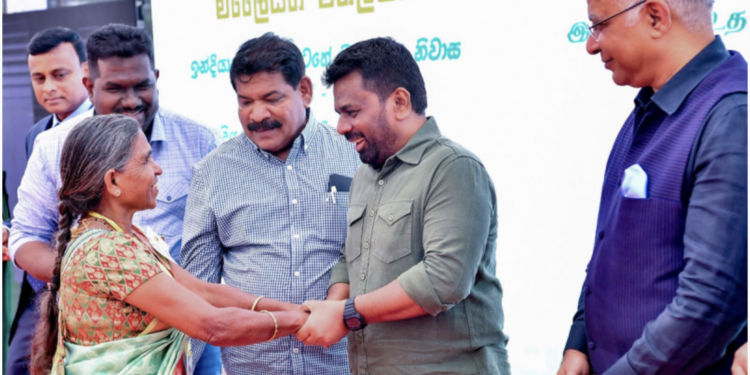
This reality changed when the issue was raised directly before President Anura Kumara Dissanayake at the Nuwara Eliya District Development Council. It was revealed that over 600 estate roads and bridges in the district are not owned by any government authority. In a decisive move, the President ordered that such roads be taken over by relevant authorities and developed procedural bottlenecks notwithstanding.
This intervention is a major political breakthrough. It opens pathways not only for road reconstruction but also for addressing long-standing land and housing demands in the Malaiyagam. Adding to this momentum, Deputy Minister of Plantation Infrastructure Pradeep Sundaralingam has spoken of plans to allocate land for housing, offering new hope to estate communities.
Legal Barriers and the Need for Reform
Despite these gains, serious obstacles remain. Chief among them is the long-term lease agreement between the government and plantation companies drafted in a vastly different political era. Certain clauses of this agreement are applied in ways that override other laws, even constitutional guarantees. These clauses have been used by some estate managements to violate fundamental rights, including Malaiyagam children’s right to preschool education.
This disaster moment is an opportune time to demand a revision of these agreements.
Similarly, the failure to fully implement the Pradeshiya Sabha Act in plantation areas continues to deny Malaiyagam people recognition as full citizens. Legal amendments are urgently needed to ensure that there are no separate, discriminatory systems for estate communities.
An Entry Point for Structural Change
Every opening for change must be widened. The President’s statements and recent government actions should be treated as entry points for deeper transformation. Ruling party members, opposition parties, and civil society organizations must act swiftly to push these reforms forward. People must be organized to ensure that promises are implemented and laws amended. The Malaiyagam voice for rights is growing but it still needs amplification.
Encouragingly, political attitudes within the Malaiyagam are changing. In some estates, workers have voluntarily donated a day’s wage to the Presidential Relief Fund despite their hardships. This signals a new spirit of collective responsibility and confidence.
Political Antics and the Need for Vigilance
Yet, alongside hope, there are attempts to undermine this emerging consciousness. Discredited politicians rejected in their own regions have resurfaced in the Malaiyagam with reckless proposals, such as resettling estate communities in the North and East. These statements not only triggered resistance from Eastern organizations but also insulted the decades-long struggle of Malaiyagam people to secure their identity, land, and existence where they live.
The burning of Namal Rajapaksa’s effigy in protest against his opposition to plantation wage hikes sent a clear political message. Attempts to reintroduce such figures as “saviors” of Malaiyagam land rights only expose how out of touch certain political actors have become.
Choosing Hope Over Fear
Today, the Malaiyagam stands at a crossroads. On one side, there is fear—amplified by narratives of land “splitting” and hopelessness. On the other, there are slowly opening doors of reform, dignity, and rights.
The choice before the people is clear: to widen these doors and move forward, or to be pushed back into despair. Intellectuals and civil society have a vital responsibility to guide and encourage the people at this critical juncture.
As Desmond Tutu reminds us:
“Hope is being able to see that there is light despite all of the darkness.”
In the Malaiyagam today, that light though fragile is undeniably visible.