Kremlin Welcomes Trump’s New National Security Strategy, Citing “Convergence” on Global Vision
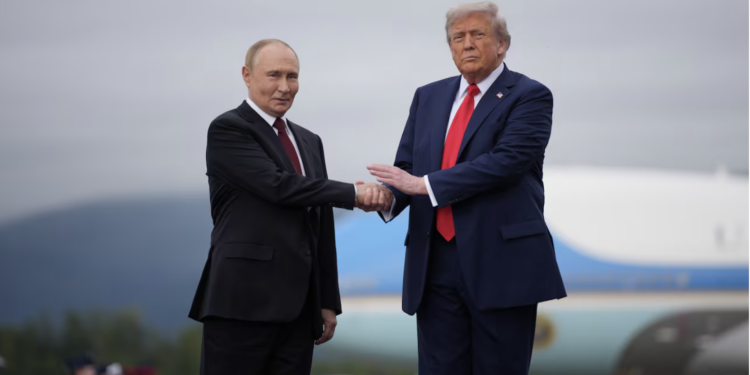
The Kremlin has offered rare praise for the United States’ new national security strategy, saying the framework unveiled by US President Donald Trump aligns closely with Russia’s own worldview and signals a notable shift in Washington’s geopolitical posture. The strategy document, released last week, warns that Europe faces what it calls “civilizational erasure,” elevates ending the war in Ukraine to a “core” US interest, and gestures toward a return to strategic stability with Moscow after years of confrontation.
Kremlin spokesperson Dmitry Peskov said on Sunday that the revised approach “corresponds in many ways to our vision,” highlighting language that downplays the idea of NATO as a “perpetually expanding alliance.” Moscow has long opposed NATO enlargement, framing it as a direct threat to its security.
Peskov, however, added a note of caution, suggesting that the “deep state” in Washington, borrowing a term Trump has used to describe officials he believes obstruct his agenda may ultimately interpret or implement the strategy differently from the president’s stated intentions.
Ukraine War Diplomacy Enters a Critical Phase
The US shift is particularly striking against the backdrop of a decade of deteriorating relations following Russia’s 2014 annexation of Crimea and the 2022 full-scale invasion of Ukraine. Previous US national security strategies consistently cast Moscow as a destabilising actor challenging the post-Cold War international order.
Trump has taken a markedly different approach, publicly clashing with Ukrainian President Volodymyr Zelenskyy and frequently praising Russian President Vladimir Putin as a “friend.”
The release of the new strategy comes as US-led diplomatic efforts to end the conflict reach a decisive moment. Zelenskyy is scheduled to travel to London on Monday for a four-way meeting with UK Prime Minister Keir Starmer, French President Emmanuel Macron, and German Chancellor Friedrich Merz.
European capitals have remained firm in backing Ukraine, even as US officials under Trump have in some instances echoed Moscow’s insistence that any peace agreement must involve Kyiv considering territorial concessions something Zelenskyy has consistently rejected.
Focus on China Recasts Washington’s Global Priorities
Trump’s strategy also marks a profound reorientation of US foreign policy toward the Indo-Pacific, framing the region as the central theatre of global competition. The document identifies China as the primary long-term challenge and pledges expanded US military capabilities to deter conflict across the Taiwan Strait.
The Kremlin’s warm reception must also be viewed in the context of Russia’s deepening alignment with China. Moscow, heavily sanctioned and increasingly isolated by the West, has strengthened political and economic ties with Beijing. Trump has repeatedly warned that such a partnership poses a strategic threat to the United States, telling Fox News in March: “The first thing you learn is you don’t want Russia and China to get together.”
A Redefinition of the Post-World War II Order
Analysts say the strategy encapsulates Trump’s ambition to overhaul the US-led international system established after World War II, recasting alliances and institutions through an “America First” lens.
One of the document’s most contentious themes is its emphasis on defending Europe’s “Western identity” and preventing what it calls “civilizational erasure.” Scholars note that this framing mirrors narratives commonly associated with far-right movements in both Europe and the United States, potentially signaling a significant ideological shift in US strategic thinking.
For Moscow, however, the language appears to validate long-standing critiques of Western political evolution and may open new areas of rhetorical and possibly diplomatic alignment.
Whether these convergences translate into durable policy change remains uncertain. Much will depend on the internal dynamics within Washington, the positions of European partners, and the outcomes of rapidly evolving diplomacy surrounding the war in Ukraine.