Sri Lanka Reels from Worst Natural Disaster in Two Decades
Sri Lanka is facing its most devastating natural disaster in 20 years, as record-breaking rains and widespread flooding continue to reveal their deadly impact. Officials warn that the full extent of destruction in the hardest-hit central regions is only now emerging, with relief workers still struggling to clear roads blocked by fallen trees, landslides, and thick mud.
The Disaster Management Centre (DMC) confirmed that the death toll has surged to 334, up sharply from 212 earlier on Sunday. Nearly 400 people remain missing, and more than 1.3 million across the island have been affected by the relentless rains that battered the country for days.
President Anura Kumara Dissanayake, who declared a nationwide state of emergency, described the catastrophe as unprecedented in scope.
“We are facing the largest and most challenging natural disaster in our history,” he said in a national address. “Certainly, we will build a better nation than what existed before.”
The scale of disruption is the worst since the 2004 Asian tsunami, which killed approximately 31,000 people and displaced more than a million.
Massive Rescue Efforts Underway
Though rainfall subsided on Sunday, parts of Colombo remained submerged, and authorities prepared for a major and prolonged relief effort.
A Sri Lankan Air Force Bell 212 helicopter delivering food to patients stranded north of Colombo crashed into a river on Sunday evening. All five crew members survived and were taken to a nearby hospital.
International assistance has begun arriving. An Indian helicopter rescued 24 people in the central town of Kotmale, including a pregnant woman and a man in a wheelchair. Pakistan is sending rescue teams, while Japan has dispatched an assessment team and pledged support.
In the northern town of Chilaw submerged a day earlier, air force crews rescued two infants and a 10-year-old child after rising waters cut off a local hospital.
Authorities say floodwaters in the capital may take at least another day to recede. Meanwhile, Cyclone Ditwah, which contributed to the extreme weather, moved north toward India on Saturday, offering some respite.
Communities Devastated
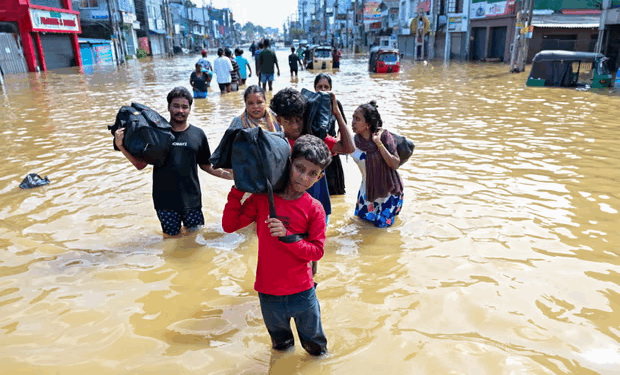
In the Colombo suburb of Wennawatte, residents fled their homes carrying only what belongings they could gather.
“My house is completely flooded,” said 46-year-old Selvi, who left with four bags of clothing and valuables. “I don’t know where to go, but I hope there is some safe shelter where I can take my family.”
In Manampitiya, 250 kilometres northeast of Colombo, receding waters exposed extensive destruction.
“Manampitiya is a flood-prone town, but I have never seen such a volume of water,” said 72-year-old S. Sivanandan. He described businesses destroyed and a car overturned in front of his shop.
In the central region around Wellawaya, residents described terrifying scenes of boulders and uprooted trees tumbling down mountainsides.
“I heard a loud noise and went outside to see boulders rolling down,” one woman said from a temporary shelter. “We are afraid to go back to our homes.”
Strain on Essential Services
Despite the enormous scale of destruction, the National Blood Transfusion Service reported a shortage of blood supplies, an alarming development even though the disaster has caused relatively few injuries compared to the number of deaths and displaced.
Sri Lanka has not experienced flooding of this magnitude since **June 2003**, when 254 people died.
As the nation struggles to account for the missing and support more than a million affected residents, rescue operations and humanitarian aid efforts are intensifying. The government, alongside international partners, now faces the enormous challenge of rebuilding lives, infrastructure, and communities shattered by the catastrophic floods.