Religion and Political Identity in Sri Lanka: Continuity Amidst Change in the Post-Aragalaya Era
Cleavage politics has long shaped the contours of Sri Lanka’s party system and political behaviour. Since independence in 1948, political analysts have identified caste, religion, ethnicity, and especially language as central fault lines that define the country’s electoral landscape. These divisions have not only framed voter preferences but have also served as tools of political mobilisation and contestation. Although Sri Lanka has witnessed momentous political transformations, most recently with the rise of the National People’s Power (NPP) in 2024, the persistence of these cleavages suggests that their influence remains deeply entrenched.
Ethno-Religious Cleavages: A Historical Constant
The post-independence history of Sri Lanka provides ample evidence of how ethno-religious divisions have dominated political discourse and decision-making. From the earliest years, political leaders have exploited these cleavages for electoral gain. For instance, the Bandaranaike-Chelvanayakam Pact (1957) and the Dudley-Chelvanayakam Pact (1965) were both attempts at resolving Tamil grievances but ultimately served as focal points for Sinhala nationalist backlash. These episodes not only derailed reconciliation efforts but also entrenched communal identities within the political sphere.
The 1972 Constitution further institutionalised ethno-religious cleavages. Spearheaded by a coalition government led by the Sri Lanka Freedom Party (SLFP), the new constitution gave Buddhism “the foremost place,” a symbolic and substantive nod to Sinhala Buddhist primacy. This move alienated minority communities and marked a turning point in the Sinhala-Buddhist majoritarian project. Such policies laid the groundwork for the eruption of ethno-religious violence, culminating in the infamous ‘Black July’ riots of 1983, where state complicity in anti-Tamil pogroms exposed the depth of ethnonationalist politics.
The rhetoric of then-President J. R. Jayewardene, who prioritised Sinhala sentiments over Tamil welfare, reflected a broader political logic: that electoral success could be secured by pandering to Sinhala-Buddhist majoritarianism, even at the cost of national unity. His infamous declaration“ If I starve the Tamils out, the Sinhala people will be happy” epitomised this political strategy.
Cleavages in the 21st Century: Escalation and Electoral Strategy
The post-civil war period did not bring about a reconciliation of ethno-religious divides. Instead, these cleavages continued to be leveraged. In the 2004 elections, the rise of the Jathika Hela Urumaya (JHU) , a party composed largely of Buddhist monks, demonstrated the electoral viability of Sinhala-Buddhist nationalism. The JHU’s success reinforced the idea that political legitimacy could be derived not from inclusive governance, but from ethnic and religious exclusivism.
Under Mahinda Rajapaksa’s leadership, this dynamic deepened. Rajapaksa’s 2010 presidential campaign was buoyed by the military defeat of the Tamil Tigers, which he framed as a triumph of the Sinhala nation. His brother, Gotabaya Rajapaksa, adopted a similarly divisive strategy during the 2019 presidential election, capitalising on post-Easter Sunday anti-Muslim sentiment to galvanise Sinhala-Buddhist voters.
These trends point to a political culture where communal identity remains a more potent driver of electoral behaviour than ideology or governance outcomes. Rather than moving beyond such cleavages, Sri Lankan politics until recently appeared to double down on them.
A New Dawn? The Rise of the NPP and the Post-Aragalaya Moment
The political landscape seemed to undergo a seismic shift in 2024, following the fallout from the 2022 Aragalaya protest movement. These protests, driven by economic despair and political frustration, led to the collapse of the Rajapaksa regime and ushered in the NPP, a political force that positioned itself explicitly against the status quo.
The NPP campaigned on a platform of inclusivity, economic justice, and systemic reform. Crucially, it rejected the ethno-religious mobilisation strategies that had dominated Sri Lankan politics for decades. Many hoped this marked the beginning of a post-cleavage political era, where broad-based policy concerns would finally eclipse communal identities as the basis of political allegiance.
The Limits of Reform: NPP and Sinhala-Buddhist Symbolism
However, the NPP’s time in office has revealed the enduring grip of ethno-religious cleavages on Sri Lankan politics. While the party has avoided overt Sinhala-Buddhist rhetoric, it has not remained immune to the demands of majoritarian sentiment. Symbolic gestures, such as participation in key Buddhist ceremonies or the reaffirmation of Buddhism’s constitutional supremacy, suggest strategic positioning by the NPP to avoid alienating the Sinhala-Buddhist electorate.
Moreover, the NPP has come under criticism from segments of the Buddhist clergy, who accuse the government of undermining the privileged status of Buddhism and insufficiently defending Sinhala-Buddhist interests. This backlash indicates that even a reformist, ostensibly secular party cannot fully escape the gravitational pull of ethno-religious politics.
The Role of the Clergy: Persistent Influence Beyond State Power
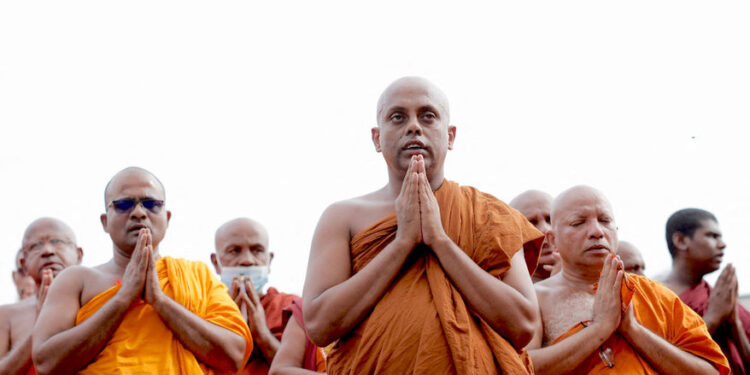
Despite the NPP’s efforts to chart a new course, Buddhist monks continue to wield significant influence in shaping political discourse. Operating both within and outside institutional frameworks, the Sangha has historically played a central role in legitimising political authority and influencing public opinion. Their criticism of the NPP reveals a continued expectation that political leadership must prioritise Sinhala-Buddhist interests, regardless of party ideology.
This phenomenon highlights a broader structural reality: ethno-religious cleavages are not merely political tools but are embedded in the cultural and institutional fabric of the country. As such, they persist even under regimes that seek to move beyond them.
Conclusion: Cleavage Politics in a Transforming Political Culture
The NPP’s rise to power offered a brief moment of optimism that Sri Lanka might finally transcend the divisive ethno-religious politics that have defined its post-independence history. However, a closer analysis reveals that even this transformative moment has not escaped the enduring influence of Sinhala-Buddhist majoritarianism.
While the NPP has attempted to redefine the political narrative around inclusive governance and structural reform, its concessions to Buddhist symbolism and its ongoing negotiation with the demands of the Sangha underscore the resilience of cleavage politics in Sri Lanka.
The country’s political future may yet hold the promise of change, but for now, ethno-religious cleavages remain a defining, if evolving, feature of its political landscape. The challenge ahead lies in transforming the underlying structures that sustain these divisions, rather than merely managing their surface manifestations.