Sri Lanka’s UNGA Address: A Call for Global Conscience and Collective Action
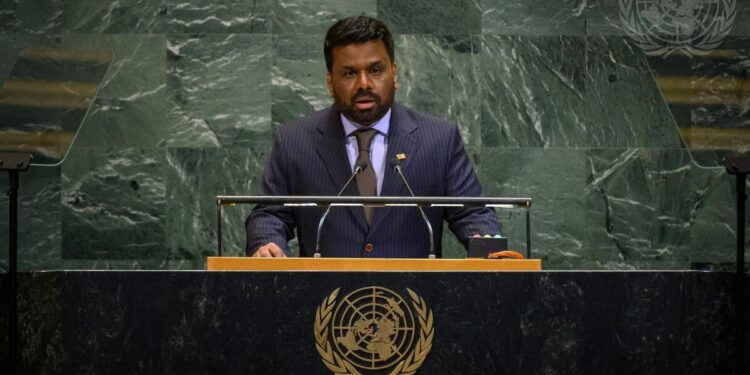
In a poignant and powerfully resonant address at the 80th Session of the United Nations General Assembly (UNGA), Sri Lankan President AKD delivered a sweeping vision for a more just, equitable, and peaceful world, one rooted in the collective conscience of humanity.
Speaking for the first time before the General Assembly as the head of state, President AKD outlined an agenda that bridged urgent global crises with Sri Lanka’s own aspirations for recovery and transformation. The speech, though firm in tone, was a clarion call for unity, compassion, and moral courage in the face of complex global challenges.
A Voice from the Global South
President AKD’s speech began with warm congratulations to the newly appointed President of the UNGA, German Foreign Minister Annalena Baerbock, and paid tribute to the leadership of her predecessor, Philemon Young. Yet it quickly pivoted to the weightier matters of global poverty, debt injustice, corruption, and the suffering caused by war, particularly from the lens of developing nations.
His emphasis on the “painful and relentless struggle” against poverty underscored the disparity between wealthy and low-income nations. AKD warned that poverty remains the most persistent threat to humanity and a violation of children’s rights across the globe. “In a world which boasts of its technological advances, how can there be children without access to education?” he questioned, urging wealthier states to recognise that investment in education is not charity, but a global imperative.
Notably, he linked the poverty crisis to debt bondage, highlighting how low-income nations spend “twice as much on debt servicing than on education or healthcare.” This, he said, traps developing countries in cycles of dependency, undermining both democratic stability and sustainable development.
On Drugs, Corruption, and Crime: A Global Epidemic
Moving beyond economics, the Sri Lankan President turned his attention to the interlinked issues of drugs, corruption, and organised crime, calling them a “global catastrophe” that undermines governance and democracy. Citing the 2025 World Drug Report, he painted a dire picture of transnational criminal syndicates who turn entire states into “hunting grounds,” and proposed a coordinated, global crackdown including stronger legal frameworks and expanded rehabilitation networks.
“Let me remind you,” he stated, “that fighting corruption is dangerous, but not fighting corruption is even more dangerous.” He tied corruption directly to poverty and the erosion of democratic values, arguing that the international community must not shy away from this battle. In a rare personal note, he reminded delegates that Sri Lanka, a relatively small nation, has taken its first steps toward non-corrupt governance, stating: “If the courageous first step we take is correct, a thousand steps will follow.”
A Moral Stand on Gaza and the Two-State Solution
AKD’s speech took on an unambiguous moral tone as he addressed the ongoing crisis in Gaza. Declaring it an “open prison full of pain and suffering,” he condemned the international community’s inaction and called for an immediate ceasefire, full humanitarian access, and the release of all hostages.
The President reaffirmed Sri Lanka’s long-standing support for the two-state solution based on the 1967 borders and acknowledged the legitimate security concerns of both Israel and Palestine. His remarks were striking for their balance, expressing empathy for all victims while advocating for adherence to UN resolutions.
Against War, For Peace: A Personal and National Testimony
Coming from a nation that endured nearly three decades of civil war, AKD’s appeal against conflict carried a heavy emotional weight. “No one who sees the pain and the suffering of parents, spouses and children of the victims of war would ever dream of another war,” he said, invoking the haunting cost of violence.
Citing Sri Lanka’s post-war legislative reforms, including inclusive representation and gender equality in parliament, the President presented his country as an example of a society choosing “light over darkness.” He called on world leaders to stop feeding the military-industrial complex while millions suffer from hunger and disease.
A Bold Proposal on Artificial Intelligence
Perhaps the most forward-looking section of the address came when President AKD proposed the creation of a neutral sovereign Artificial Intelligence zone. Noting the stark digital divide between rich and poor nations, he warned that if left unchecked, AI could exacerbate inequality rather than eliminate it.
“The digital gap between states that can and cannot establish access to digital tools is clear. An even greater gap is being created in relation to artificial intelligence,” he said, framing this technological revolution as both a threat and an opportunity.
His proposal, which lacked granular detail but was ambitious in vision, called for an international framework to ensure that AI becomes a tool of dignity and development, not a force of domination.
A Concluding Call to Global Conscience
In closing, AKD invoked the founding ideals of the United Nations and quoted Harry Truman’s reminder that “in your hands rests our future.” He urged delegates to pursue their national dreams not through rivalry but cooperation, stating: “Let us not try to achieve these dreams in competition with each other, but by working arm in arm, peace, dignity, and equality on a healthy planet.”
A Leader with Moral Gravitas
President AKD’s address was notable not for grand geopolitical manoeuvring but for its depth of conscience. In a world increasingly polarised by nationalism, militarisation, and economic inequality, Sri Lanka’s leader offered an alternative vision rooted in solidarity and moral clarity.
In doing so, he reminded the world that even small nations, when guided by principle and conviction, can help shape a more compassionate global order.
As one diplomat from the African bloc was overheard saying after the speech, “He spoke for many of us, not just for Sri Lanka.”